LESCO Bill Explained 2026: How to Read Every Section of Your Electricity Bill
Most people look only at the total amount and the due date. But your electricity bill holds much more: your tariff, your readings, the meter photo, monthly adjustments, taxes and a full year of history. Having your LESCO bill explained line by line helps you spot errors, understand why the amount changed and plan your usage better.
This guide walks through every section of the bill in 2026. You will learn what each number means, which charges are new or removed, how to check that the bill is correct and where to go if something looks wrong. Keep your latest bill next to you as you read.
The Fixed Charges line is explained in detail, with the 2026 rates, in our LESCO fixed charges guide.
Table of Contents
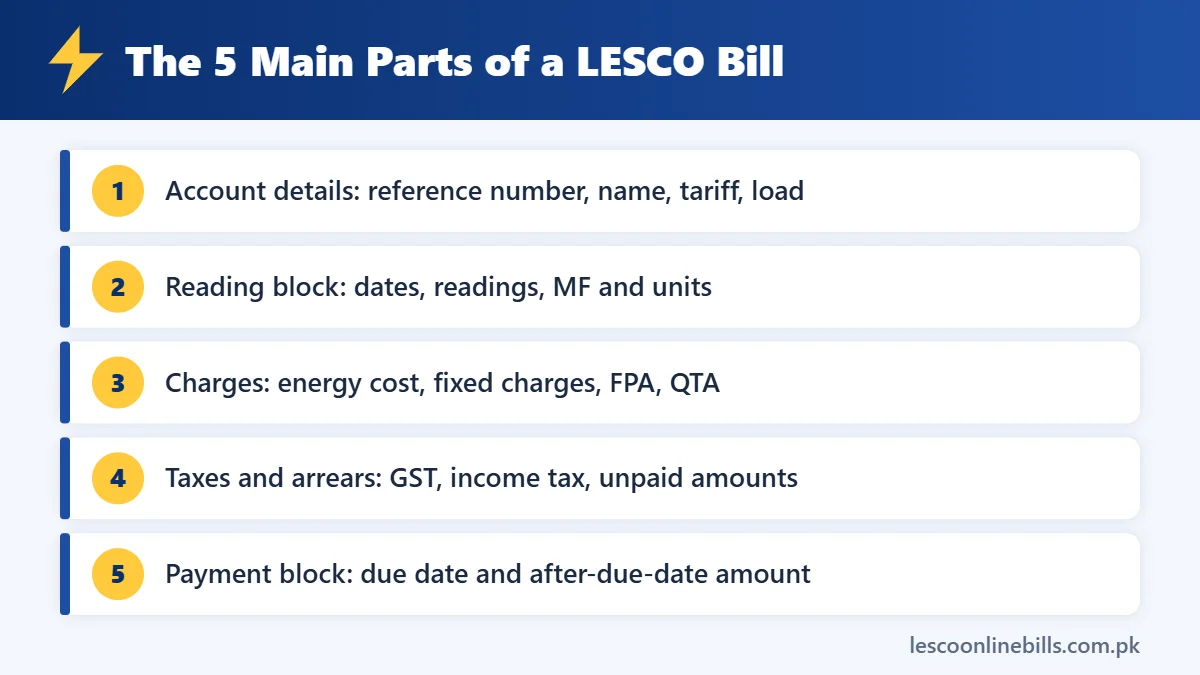
LESCO Bill Explained: The Five Main Parts
LESCO bills are printed in a standard PITC format used by most distribution companies. The layout looks busy, but it follows a logical order. Once you know the five parts, every bill becomes easy to read.
- Account details: who you are and what kind of connection you have.
- Reading block: how many units you used and when the meter was read.
- Charges: what those units cost, plus monthly and quarterly adjustments.
- Taxes and arrears: government taxes and any unpaid amounts.
- Payment block: how much to pay, by when and what happens if you are late.
If you need a fresh copy to follow along, download it from our LESCO bill check online tool or our LESCO duplicate bill guide.
LESCO Bill Explained Part 1: Account Details
Reference number
The 14-digit reference number is the most important identifier on the bill. It links your meter to your account and is used for online bill checks, payments and complaints. It includes codes for your batch and sub-division, plus a serial number, and ends with a letter showing urban or rural. Our LESCO reference number guide explains it in detail.
Customer ID
The customer ID is a second identifier. You can use it instead of the reference number to download a bill. See our LESCO bill by customer ID page.
Name and address
This shows the registered consumer. If it still shows a previous owner, consider a name change so the connection is legally yours.
Tariff
The tariff code tells LESCO which rates to apply. Having the tariff part of your LESCO bill explained is important, because a wrong tariff can multiply your bill.
| Tariff code | Meaning |
|---|---|
| A-1(a) | Residential, sanctioned load below 5 kW |
| A-1(b) | Residential, 5 kW and above, time-of-use |
| A-2 | Commercial |
| A-3 | General services |
| B-1 to B-4 | Industrial |
| C | Bulk supply |
| D | Agriculture |
| E | Temporary supply |
Sanctioned load and connected load
Sanctioned load is the approved maximum in kW. If you regularly use more, you may receive a notice to extend it. Our LESCO load extension guide explains the process.
LESCO Bill Explained Part 2: The Reading Block
This section shows how your units were calculated. It is the part most worth checking every month:
- Reading date: when the meter was read this month.
- Previous and present reading: the two meter numbers used.
- MF (multiplying factor): usually 1 for homes.
- Units consumed: (present minus previous) times MF.
- Meter photo: a snapshot of your meter, which NEPRA rules make mandatory.
On time-of-use connections you will also see peak and off-peak units. For solar users, import and export units appear separately. Our LESCO meter reading guide shows how to compare these numbers with your meter.
LESCO Bill Explained Part 3: Charges
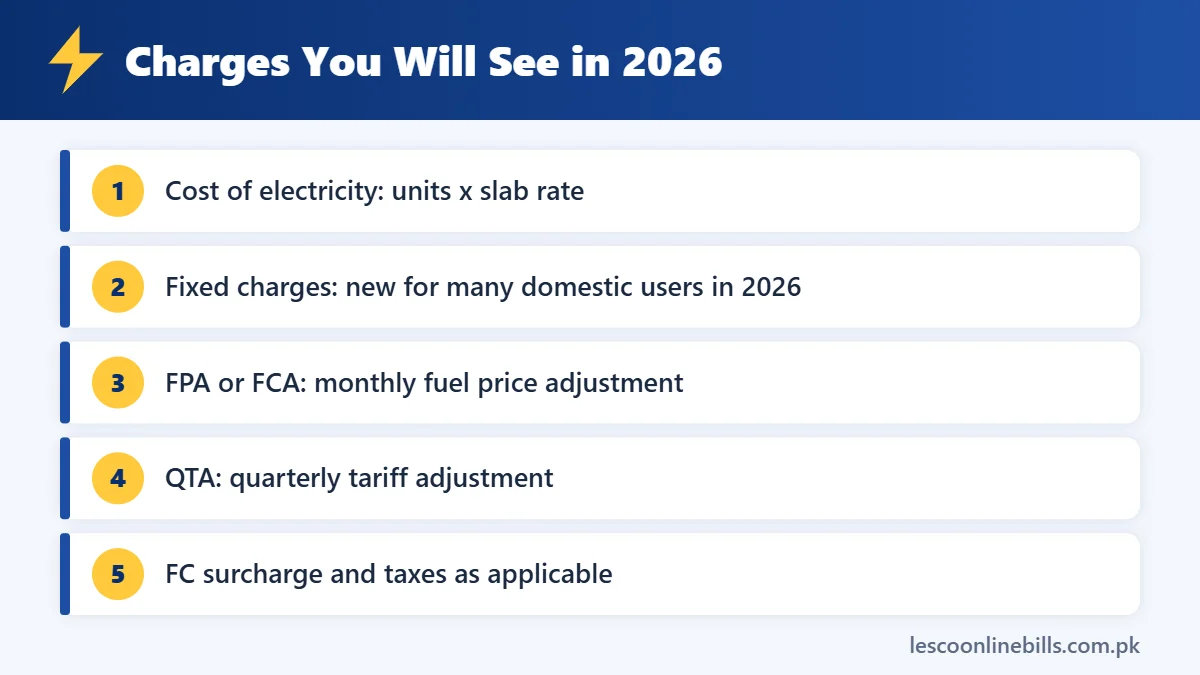
The charges section turns units into rupees. In 2026 it includes several items that confuse many readers, so here is each one with the LESCO bill explained simply.
Cost of electricity
Your units multiplied by the slab rate for your tariff. Domestic rates rise as you move into higher slabs, and protected consumers pay lower rates. See current rates on our LESCO unit rate page.
Fixed charges
In February 2026, NEPRA introduced fixed monthly charges for domestic consumers. Reports described amounts roughly between Rs200 and Rs675 depending on the consumption band, with lifeline consumers exempt. Different reports described the calculation differently, and a review petition was filed, so check the fixed charges line on your own bill.
FPA or FCA (fuel price adjustment)
A monthly per-unit adjustment based on the actual cost of fuel used to generate electricity two months earlier. It can be a charge or a credit. For example, NEPRA allowed an adjustment of about Rs1.11 per unit for August 2026, charged in October 2026 bills. Lifeline consumers are usually exempt.
QTA (quarterly tariff adjustment)
A per-unit adjustment applied for three months at a time. An increase of about Rs0.52 per unit applied in September, October and November 2026 bills.
FC surcharge and other surcharges
Surcharges linked to the power sector’s debt are added per unit. A debt servicing surcharge of about Rs3.23 per unit was reported to continue in 2026. The exact labels and amounts on your bill may differ, so read the line items carefully.
LESCO Bill Explained Part 4: Taxes and Arrears
Government taxes are calculated on the electricity charges. The main ones are general sales tax, income tax for some consumers and extra or further tax for certain unregistered commercial users. Two items were removed in 2025:
- Electricity duty: stopped through bills from 1 July 2025.
- PTV fee: the Rs35 TV fee was removed from July 2025.
Income tax on domestic bills generally applies only above a certain bill amount for people not on the Active Taxpayers List. Our LESCO bill taxes guide has the full breakdown, and the LESCO tax certificate guide shows how to claim tax paid on bills.
Arrears and adjustments
Arrears show unpaid amounts from earlier months. If you see arrears for a month you already paid, keep the receipt and use our LESCO bill paid or not guide to check the record. Adjustments, such as credits from a corrected bill, also appear here.
Installments and deferred amounts
If you were allowed to pay a large bill in parts, the installment for this month and the remaining balance are shown. Our LESCO bill installment guide explains the rules.
LESCO Bill Explained Part 5: The Payment Block
This is where most people look first. It shows:
- Due date: under NEPRA rules, generally within 15 days of the bill being issued, with at least seven clear days after delivery.
- Payable within due date: the amount to pay on time.
- Payable after due date: the higher amount that includes the late payment surcharge.
- Bank and QR details: a barcode or QR code that lets you pay quickly. See our LESCO bill QR code guide.
Paying late can also lead to disconnection notices. Pay through any of the methods in our LESCO online bill payment guide.
LESCO Bill Explained With a Sample Domestic Bill
Seeing real numbers is the easiest way to understand a bill. The sample below is an illustration only, based on a typical non-protected home in Lahore. Your own rates, adjustments and taxes will be different, so always use the figures printed on your bill.
| Bill line | Sample value | What it means |
|---|---|---|
| Tariff | A-1(a) | Residential, below 5 kW |
| Reading dates | 2 Sept to 2 Oct | 30-day cycle, no pro-rata issue |
| Readings | 12,310 to 12,560 | 250 units with MF 1 |
| Cost of electricity | 250 units x slab rate | Main energy charge |
| Fixed charges | As printed | New monthly charge from 2026 |
| FPA and QTA | Per-unit adjustments | Monthly and quarterly changes |
| GST | On electricity charges | Sales tax collected for the government |
| Arrears | 0 | Last bill paid on time |
With this sample LESCO bill explained, the logic is clear: units drive the cost of electricity, adjustments are added per unit, fixed charges are added once per month, and taxes are calculated on top. If your units look normal but the amount jumped, the cause is usually an adjustment or tax change rather than a reading error.
You can compare your bill with the official copy on the PITC LESCO bill portal, and review approved tariffs on the NEPRA LESCO tariff page. Our LESCO bill calculator also helps you estimate the amount from your units.
LESCO Bill Explained for Solar Users
If you have rooftop solar, your bill has extra lines. You will see import units (power taken from LESCO), export units (power sent to the grid) and, on many bills, two meter photos. Under net billing for new users, imported units are charged at your normal tariff, while exported units earn a lower export rate as a credit. Older net metering users may see units offset directly.
When you read a solar bill, check that both import and export readings match the meter, and that the export credit appears. Some LESCO solar bills in early 2026 were reprinted because export units were missing. Our LESCO net metering guide has the solar side of the LESCO bill explained in full.
LESCO Bill Explained for Shops and Businesses
Commercial bills follow the same layout with a few differences. The tariff is usually A-2, rates are higher than domestic rates and time-of-use pricing applies at 5 kW and above, with separate peak and off-peak units. Extra or further tax may apply to some unregistered commercial consumers, and income tax rules are different from those for homes.
For businesses, the most useful habit is to track peak units each month. Shifting heavy work outside peak hours can noticeably reduce the bill. Our LESCO peak hours guide lists current timings, and having your commercial LESCO bill explained by your accountant once a year can help you claim tax correctly.
Smart Meter Bills and Detection Charges
If you recently received an AMI smart meter, the reading block may show readings collected remotely. The rest of the bill stays the same. Our LESCO smart meter guide explains how these meters work. A detection bill, on the other hand, must now be issued separately, with its own reasons, units and period. It should not appear silently inside your normal bill.
The 12-Month Bill History Table
Every LESCO bill includes a history of units and amounts for the previous months. It is one of the most useful sections, yet many people ignore it. Use it to:
- Compare this month’s units with the same month last year.
- Spot sudden jumps that may point to a reading or meter problem.
- Check whether you stayed within 200 units for the last six months to keep protected status.
- Plan your summer usage based on previous years.
Protected and Non-Protected Status
Domestic consumers who use 200 units or fewer per month over the previous six months are treated as protected and pay lower rates. Crossing 200 units, even once, can move you to non-protected rates for the next six months. The government has also said it plans to phase out the protected category by 2027, so watch for changes. Our LESCO bill subsidy guide explains the current position.
Common Misreadings to Avoid
- Confusing the reading with units: the present reading is a running total, while units are the difference between two readings.
- Paying the after-due-date amount by mistake: check which column you are paying before the due date.
- Treating FPA as an error: fuel adjustments change every month and can be a charge or a credit.
- Ignoring arrears: an old unpaid amount keeps adding to future bills until it is cleared or corrected.
- Missing the tariff code: a wrong tariff is rare but costly, so confirm it once in a while.
Keeping these points in mind makes every LESCO bill explained in this guide quick to verify, even when the total looks higher than usual. If you are still unsure about a line, call the 118 helpline with your reference number and ask them to read it out with you.
Quick Monthly Bill Check
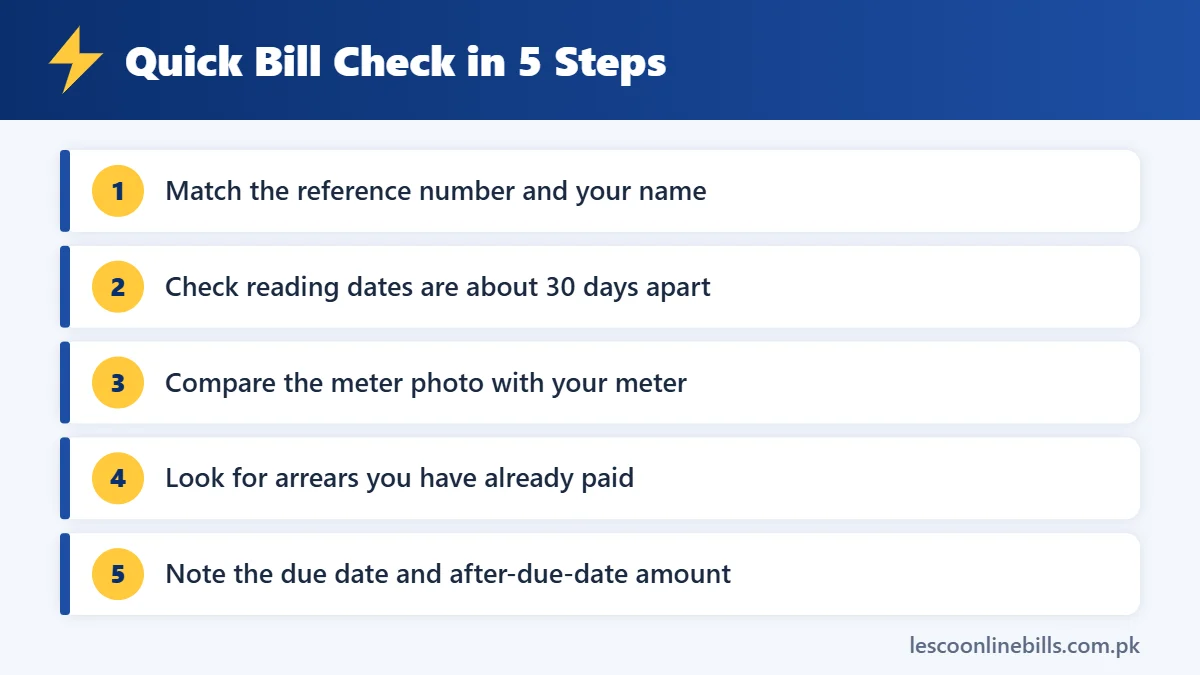
Once you have your LESCO bill explained, a five-minute check each month is enough:
- Confirm the reference number, name and tariff.
- Check that the reading dates are about 30 days apart.
- Compare the meter photo and present reading with your meter.
- Look for arrears or detection charges you do not recognise.
- Note the due date and pay before it.
If something is wrong, our LESCO bill correction guide shows how to fix it, and our LESCO detection bill guide covers theft-related charges.
LESCO Bill Explained FAQs
How do I read my LESCO bill?
Start with the account details at the top, then check the reading block for dates, readings and units. Next, review the charges, taxes and arrears, and finally note the amount payable within the due date and after it.
What are fixed charges on a LESCO bill in 2026?
NEPRA introduced fixed charges for domestic consumers in early 2026. The amount depends on your consumption band and, in some reports, your sanctioned load. Lifeline consumers are exempt. Check the fixed charges line on your own bill for the exact figure.
What do FPA and QTA mean on my bill?
FPA (fuel price adjustment) is a monthly per-unit charge or credit based on the actual cost of fuel used to generate power. QTA (quarterly tariff adjustment) is a per-unit adjustment applied for three months. For example, a QTA of about Rs0.52 per unit applied in September to November 2026 bills.
Has the TV fee been removed from electricity bills?
Yes. The Rs35 PTV fee was removed from electricity bills in July 2025. Electricity duty was also stopped through bills from 1 July 2025.
How do I know if I am a protected consumer?
Protected status applies to domestic users who use 200 units or less per month over the previous six months. Your bill shows whether protected rates apply. Crossing 200 units can remove the status for the following six months.
What is the late payment surcharge on a LESCO bill?
The bill shows two amounts: payable within the due date and payable after the due date. The difference is the late payment surcharge. Pay before the due date to avoid it.
Final Words
With your LESCO bill explained section by section, the numbers stop being a mystery. Check the account details, reading block, charges, taxes and payment block every month, and use the 12-month history to spot problems early. Register your mobile number through our LESCO SMS registration guide for alerts, and download your latest bill anytime on our LESCO online bill tool.