LESCO Peak Hours 2026: Latest Timings, Rates & 9 Easy Saving Tips
LESCO peak hours are the four evening hours each day when electricity costs more for consumers who have a time-of-use (TOU) meter. If your bill shows “Peak” and “Off-Peak” units and the total keeps rising, these hours are usually the reason.
Many people in Lahore, Kasur, Okara, Sheikhupura and Nankana Sahib know that peak hours exist, but not the exact times, which months they change, or who actually pays the higher rate. Some also confuse them with the evening power cuts announced in 2026.
This guide gives you the current 2026 timings for every season, the verified peak and off-peak rates, how to read these units on your bill, and simple ways to move your heavy load to cheaper hours.
Table of Contents
LESCO Peak Hours 2026: Season-by-Season Timings
The timings below come from the NEPRA tariff determination for LESCO dated 7 January 2026, which uses the same four seasonal windows as all other ex-WAPDA distribution companies. Each window is exactly four hours long.
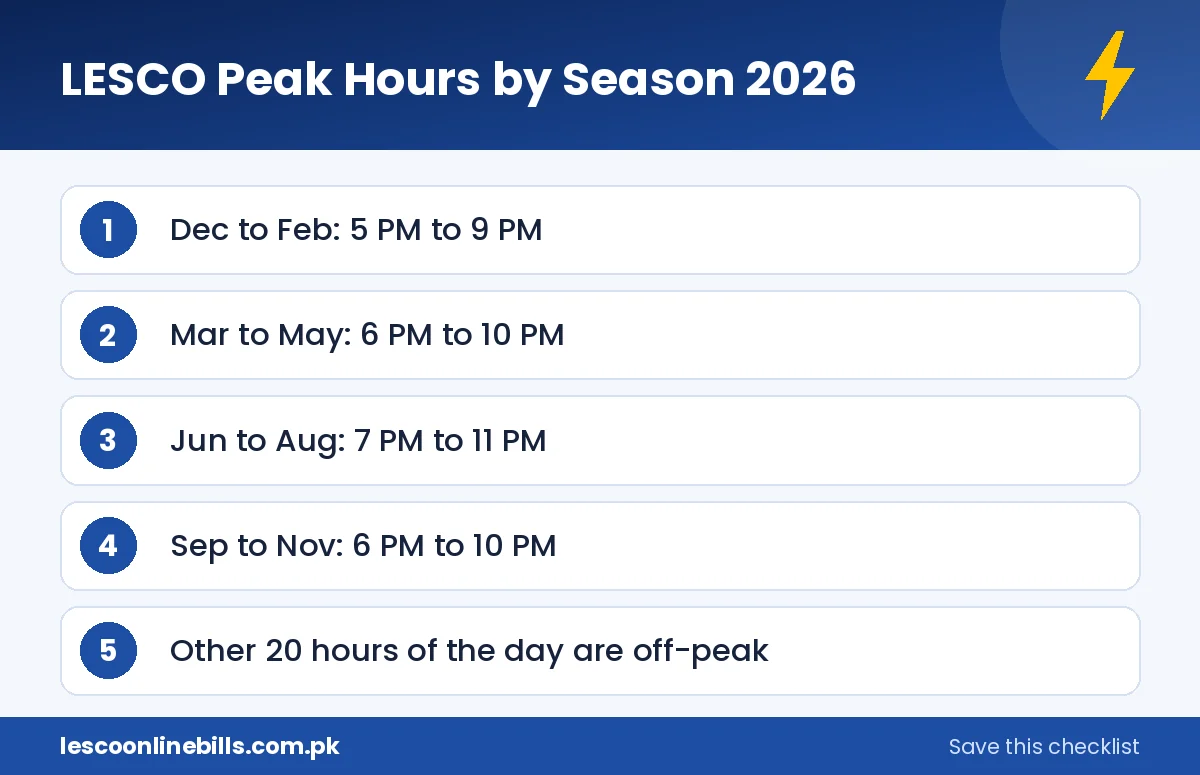
| Season | Months (inclusive) | Peak hours | Off-peak hours |
|---|---|---|---|
| Winter | December to February | 5:00 PM to 9:00 PM | Remaining 20 hours |
| Spring | March to May | 6:00 PM to 10:00 PM | Remaining 20 hours |
| Summer | June to August | 7:00 PM to 11:00 PM | Remaining 20 hours |
| Autumn | September to November | 6:00 PM to 10:00 PM | Remaining 20 hours |
Right now, in October 2026, the peak window is 6 PM to 10 PM. From 1 December it moves one hour earlier to 5 PM to 9 PM, because the sun sets earlier and evening demand starts sooner.
The tariff terms also say these timings would be adjusted if daylight saving time is ever used again. Pakistan does not follow daylight saving at present, so the table above applies as it is.
Where to confirm the official timings
The PITC bill website, which generates LESCO bills, has a Peak/Off-Peak Timing page, and NEPRA publishes the full tariff terms. If LESCO peak hours are ever revised, these official sources will show it first, so trust them over WhatsApp forwards.
What Peak and Off-Peak Hours Actually Mean
Electricity demand in Pakistan jumps after sunset. Lights, fans, ACs, water motors and TVs all run at the same time, and the national grid has to start expensive power plants to meet that load.
To spread demand more evenly, NEPRA allows a higher “peak” price for those four evening hours and a lower “off-peak” price for the other 20 hours. A TOU meter records your units separately for each time slot, so you pay according to when you used the power, not just how much.
So the idea behind LESCO peak hours is simple: if you can move flexible work, such as ironing, washing or filling the water tank, out of the evening window, your bill goes down.
Who Pays LESCO Peak Hours Rates?
Not every LESCO customer pays extra during LESCO peak hours. The peak rate applies only where a TOU meter is installed and the connection is billed on a TOU tariff. Under the NEPRA terms and conditions for LESCO, this mainly covers the following.
Homes with 5 kW or more sanctioned load
Residential (A-1) consumers with a sanctioned load of 5 kW and above are to be given a TOU meter and billed under tariff A-1(b). This often covers larger houses that run several ACs at the same time.
Shops, offices and industries
Commercial (A-2) connections with 5 kW or more are billed on TOU tariff A-2(c) once the TOU meter is installed. Small industrial B-1 connections with 5 kW or more move to B-1(b), while B-2, B-3 and B-4 industrial consumers are billed on TOU tariffs.
Normal homes below 5 kW
Most ordinary houses have a sanctioned load below 5 kW and a simple meter. They pay the normal slab rates at any time of day, so LESCO peak hours do not change the price of their units. Saving power in the evening still lowers their total units and helps them stay in a cheaper slab.
Peak vs Off-Peak Rates in 2026
The current consumer rates come from NEPRA’s tariff rationalisation decision of 11 February 2026, notified by the government through S.R.O. 279(I)/2026. These are base energy charges per unit. Fuel price adjustment, quarterly adjustment, GST, electricity duty and other taxes are added on top.
| Category (TOU) | Peak (Rs/unit) | Off-peak (Rs/unit) | Gap per unit |
|---|---|---|---|
| Domestic A-1(b) | 46.85 | 34.53 | Rs 12.32 |
| Industrial B-1(b), up to 25 kW | 35.74 | 25.48 | Rs 10.26 |
| Industrial B-2(b), 25–500 kW | 35.68 | 22.83 | Rs 12.85 |
| Industrial B-3, 11–33 kV | 35.68 | 23.67 | Rs 12.01 |
For a TOU home, every unit used during LESCO peak hours costs about Rs 12 more in base charges than the same unit at 2 PM or midnight. Moving just 100 units a month from peak to off-peak saves roughly Rs 1,200 before taxes, and a little more once percentage-based taxes are counted.
New fixed charge for TOU homes
Since February 2026, domestic TOU consumers also pay a fixed charge of Rs 675 per kW per month, worked out on 50% of the sanctioned load or the MDI (maximum demand), whichever is higher. For example, a 10 kW house with a 4 kW MDI is charged on 5 kW, which is Rs 3,375 a month.
Rates are reset from time to time, and NEPRA has moved annual rebasing to January, so new rates may apply from 2027. For the full and latest slab list, see our LESCO unit rate page or the official NEPRA LESCO tariff page.
How to Read Peak and Off-Peak Units on Your LESCO Bill
A TOU bill looks a little different from a normal house bill. Use these steps to find your peak usage in under a minute.
- Open your latest bill online using our LESCO bill check tool, or take out the paper copy.
- Check the tariff field. A code such as A-1(b), A-2(c) or B-1(b) means you are on a TOU tariff.
- Find the meter reading section. A TOU bill shows separate previous and present readings for “Peak” and “Off-Peak”.
- Note the units for each row. Peak units are the ones used during LESCO peak hours; off-peak units are everything else.
- Look for the MDI reading. It shows the highest load your connection drew and can affect your fixed charges.
- Compare with past months. Your bill history shows whether peak units are rising or falling.
A simple rule: if peak units are more than about one fifth of your total, there is room to save, because the peak window is only one sixth of the day. To estimate a bill before it arrives, try our LESCO bill calculator.
LESCO Peak Hours News: What Changed in 2025–2026
Social media often spreads rumours that LESCO peak hours have been extended or removed. Here is what official decisions and reliable news actually say, with dates.
- July 2025: The Power Division denied reports that morning hours were being added to peak time and said there was no change in policy.
- August 2025: Some media reported that NEPRA had asked DISCOs, including LESCO, for proposals on peak hours. No new schedule was notified; the January 2026 LESCO determination still uses the same four windows.
- 9 December 2025: NEPRA approved an incremental consumption package for industrial and agricultural consumers. Extra units above their reference usage are billed at a flat Rs 22.98 per unit, for both peak and off-peak, for three years.
- 11–12 February 2026: New uniform tariff notified. Domestic TOU variable rates were cut and the Rs 675/kW fixed charge was added. Industrial off-peak rates saw the biggest cuts.
- 14 April 2026: The Power Division announced a “Peak Relief Strategy” with planned supply suspension of up to about 2.25 hours a day between 5 PM and 1 AM, due to costly imported fuel.
In short, as of October 2026, peak hour pricing has not been abolished for homes or shops. Any change would come through a NEPRA decision and a government notification, so ignore forwarded messages without a source.
9 Easy Ways to Save During LESCO Peak Hours
You do not need to sit in the dark. The goal is to move flexible tasks a few hours earlier or later, and keep only essential load running during LESCO peak hours.
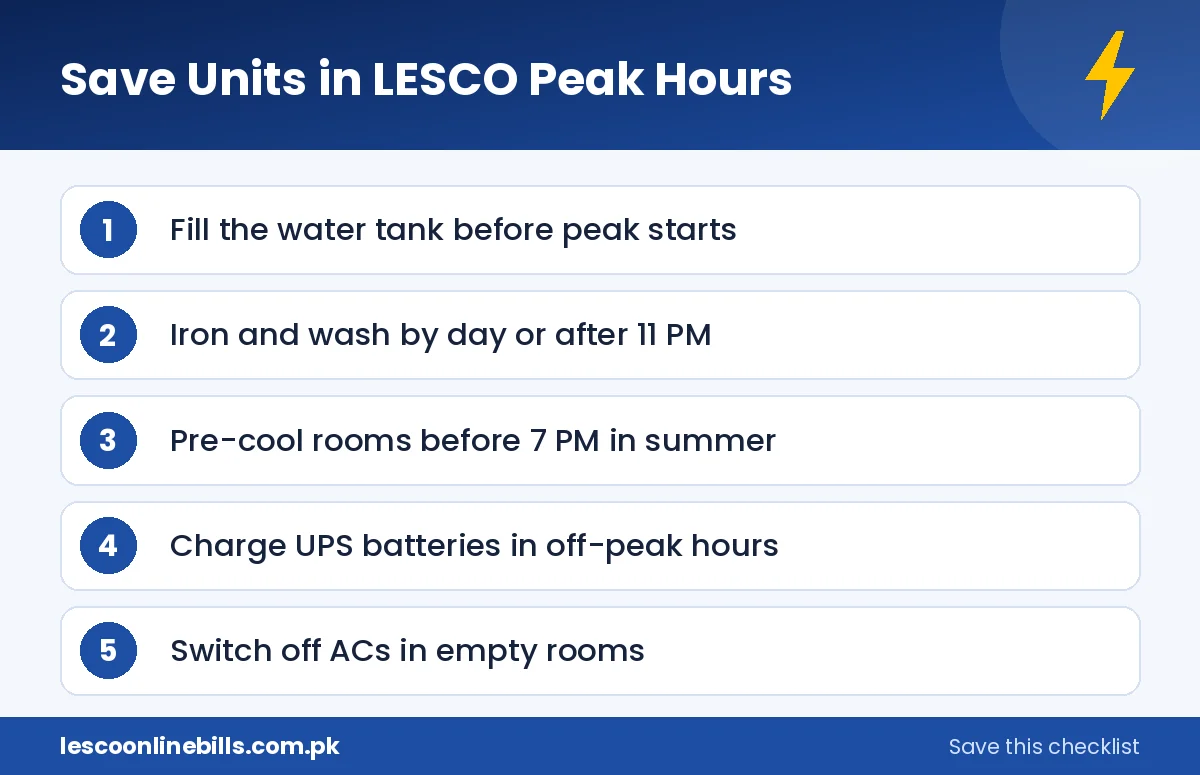
- Fill the water tank early. Run the motor in the afternoon, before 5 or 6 PM, never in the evening window.
- Iron and wash in the day. Irons and washing machines draw heavy load; do them in the morning or after 11 PM.
- Pre-cool rooms in summer. Run the AC harder before 7 PM, then raise it to 26°C during peak time.
- Use inverter ACs and timers. Inverter units and timer settings cut evening load without discomfort.
- Charge UPS batteries off-peak. Where safe, charge batteries and devices before the window starts.
- Switch off empty rooms. One unused AC or heater in the evening adds many peak units each month.
- Cook electric meals earlier. Use electric ovens, kettles and microwaves before the peak starts.
- Shift machine work. Shops and small factories can schedule welding, pumping or heavy machines outside peak time.
- Use stored solar power. Solar panels produce in the day, when rates are already off-peak, so a battery helps cover the evening.
Set a phone reminder 15 minutes before the window starts each season. Families who do this for one month usually see a clear drop in peak units on the next bill.
Common Problems and How to Fix Them
Peak units look too high
A TOU meter has its own clock. If the time or date on the meter is wrong, units used outside LESCO peak hours can be recorded in the wrong slot. Check the meter display, and if it is off, ask your LESCO sub-division to inspect it.
You think you pay peak rates but have a normal meter
If your tariff shows A-1(a) and there is no peak or off-peak row, you are on slab billing. Your units cost the same at any hour, so the extra cost is coming from total usage, not timing.
Fixed charges suddenly increased
For TOU homes, fixed charges follow sanctioned load or MDI. Running many heavy appliances together pushes MDI up. Spread them out, and if your house now needs less load, apply to LESCO to reduce the sanctioned load.
Bill reading does not match the meter
Take a clear photo of the peak and off-peak readings on the meter and compare them with the bill. If they differ, keep a LESCO duplicate bill copy and the photo when you visit the office.
How to Know if You Have a TOU Meter
There are three quick checks. First, the tariff code on your bill is a TOU code, such as A-1(b) for homes, A-2(c) for shops or B-1(b) for small industry. Second, the bill lists peak and off-peak readings separately. Third, a TOU meter’s display usually cycles through more than one reading.
If you still are not sure, call or visit your sub-division with your reference number or customer ID and ask whether your connection is billed on TOU. If it is not, LESCO peak hours do not change your unit price, and your focus should be on total units instead.
Want to see how peak and off-peak timings show up on your own meter? Our LESCO meter reading guide explains how to read the TOU registers and match them with your bill.
LESCO Peak Hours FAQs
What are LESCO peak hours today?
From September to November, LESCO peak hours are 6 PM to 10 PM. From December to February they are 5 PM to 9 PM.
Are LESCO peak hours the same in summer and winter?
No. The window starts at 5 PM in winter, 6 PM in spring and autumn, and 7 PM in summer (June to August), ending four hours later each time.
Do LESCO peak hours apply to every house?
No. The higher rate applies only to TOU-metered connections, mostly with 5 kW or more sanctioned load. Normal homes below 5 kW pay slab rates at all hours.
How much more does a peak unit cost?
For domestic TOU consumers in 2026, the base rate is Rs 46.85 peak and Rs 34.53 off-peak, a gap of about Rs 12 per unit before taxes and adjustments.
Have LESCO peak hours been abolished in 2026?
No. As of October 2026, peak pricing still applies to TOU homes and shops. Only some industrial and farm extra units get a flat rate under the December 2025 package.
Are LESCO peak hours the same as load shedding hours?
No. Peak hours decide your price per unit. Planned power cuts, like the 2026 peak relief outages, are a separate supply schedule announced by LESCO.
Final Words
Remember the four windows, check whether your tariff is TOU, and move heavy tasks outside LESCO peak hours. Even small changes, like filling the tank in the afternoon, add up over a full summer. You can view your latest units anytime with our LESCO bill by customer ID tool.
Disclaimer: LESCO Online Bills is an independent guide and is not affiliated with LESCO. For official notices, visit lesco.gov.pk.