LESCO Fixed Charges 2026: New Rates, Slabs and How to Pay Less
If your recent bill looks higher even though you used about the same number of units, you are not alone. Since early 2026, most homes in Lahore, Kasur, Okara, Sheikhupura and Nankana Sahib see a separate line called LESCO fixed charges, and many people do not know what it means or why it changes.
This guide explains LESCO fixed charges in simple words: what they are, the new 2026 rates, how they are calculated from your sanctioned load, where to find them on your bill and practical ways to keep them as low as possible. You can check your latest bill on our LESCO bill check page while you read.
Table of Contents
What Are LESCO Fixed Charges?
Your electricity bill has two main parts. The first is the variable charge, which depends on how many units (kWh) you use. The second is the fixed charge, a set amount that you pay every month even if you use very little electricity.
LESCO fixed charges help the power sector recover costs that do not change with your daily use, such as the network, meters, maintenance and capacity payments. In the past, most of these costs were added to the per-unit rate. In 2026, NEPRA moved part of them into fixed charges for domestic consumers.
That is why many households saw LESCO fixed charges appear on their bill for the first time, or saw the amount rise, even when their units stayed the same.
Why LESCO Fixed Charges Changed in 2026
In February 2026, NEPRA approved a restructuring of electricity tariffs for the ex-WAPDA distribution companies, including LESCO, and K-Electric. The new schedule was issued as S.R.O. 279(I)/2026, dated 12 February 2026. You can read NEPRA’s determination on the NEPRA website.
The key changes for homes were:
- Fixed charges now apply to most domestic consumers, including protected users who were exempt before.
- The amount depends on your monthly units and whether you are protected or unprotected.
- Lifeline consumers are excluded from these fixed charges.
- Per-unit rates were reduced slightly for many slabs at the same time, so part of the cost moved from units to fixed charges.
So LESCO fixed charges are not a LESCO-only decision. They come from NEPRA’s national tariff schedule and apply in the same way across the ex-WAPDA companies.
LESCO Fixed Charges 2026: Rate Table
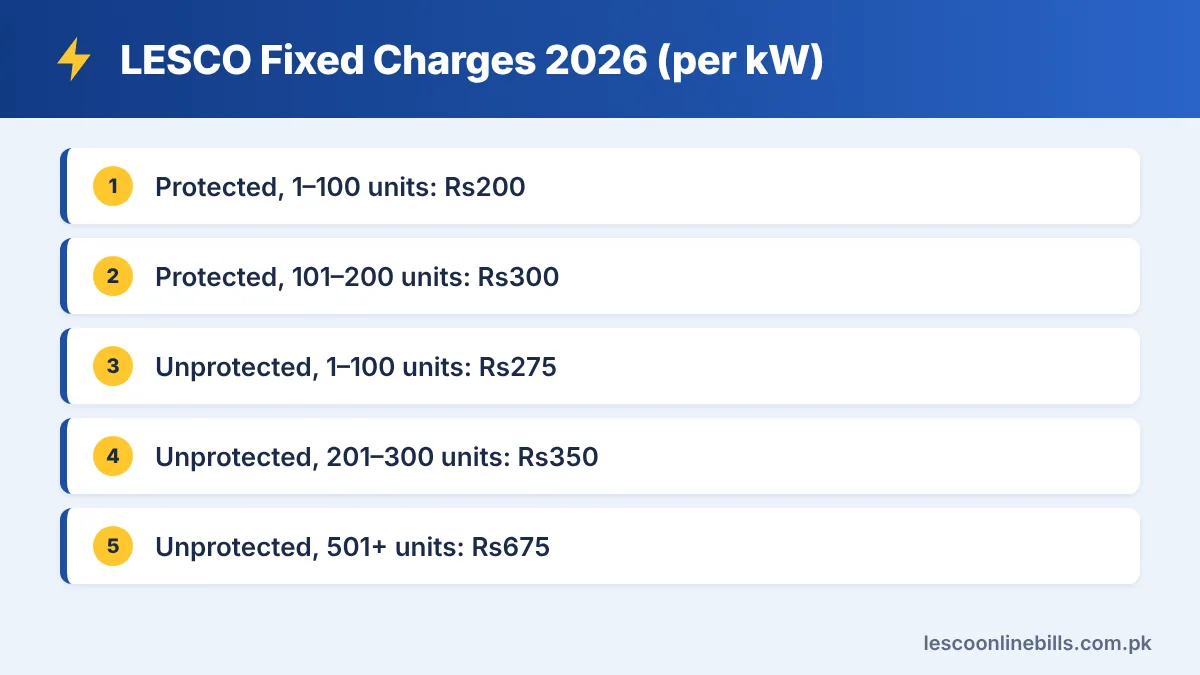
Here are the domestic (A-1, non time-of-use) LESCO fixed charges from the February 2026 schedule. Amounts are listed per kW of sanctioned load per month:
| Monthly units | Protected consumer | Unprotected consumer |
|---|---|---|
| 1 to 100 units | Rs200 per kW | Rs275 per kW |
| 101 to 200 units | Rs300 per kW | Rs300 per kW |
| 201 to 300 units | Not applicable | Rs350 per kW |
| 301 to 400 units | Not applicable | Rs400 per kW |
| 401 to 500 units | Not applicable | Rs500 per kW |
| 501 units and above | Not applicable | Rs675 per kW |
Protected consumers only appear in the first two rows because protected status ends once a home goes above 200 units. Lifeline, time-of-use, commercial and industrial consumers have separate tariff entries, so these LESCO fixed charges do not apply to them in the same way.
How LESCO Fixed Charges Are Calculated
Three things decide your LESCO fixed charges each month:
- Your units: the slab your monthly consumption falls into.
- Your status: protected or unprotected. Protected status needs 200 units or fewer in each of the last six months.
- Your sanctioned load: the load in kW written on your bill. Because the schedule lists rates per kW, a higher sanctioned load can mean a higher fixed charge.
Your sanctioned load is the load LESCO approved when your connection was installed or last extended. It is printed on the bill near your tariff and meter details. Our LESCO bill explained guide shows exactly where to find it.
Simple Example
Imagine an unprotected home with a sanctioned load of 2 kW that uses 250 units in a month. The 201–300 unit slab rate is Rs350 per kW. Using the schedule rate, the fixed charge would be 2 × Rs350 = Rs700 for that month, plus the normal cost of the 250 units, adjustments and taxes.
If the same home used 190 units and was protected, the rate would be Rs300 per kW. That is why keeping your units and status in check matters for LESCO fixed charges, not just for the unit cost.
Where to Find Fixed Charges on Your LESCO Bill
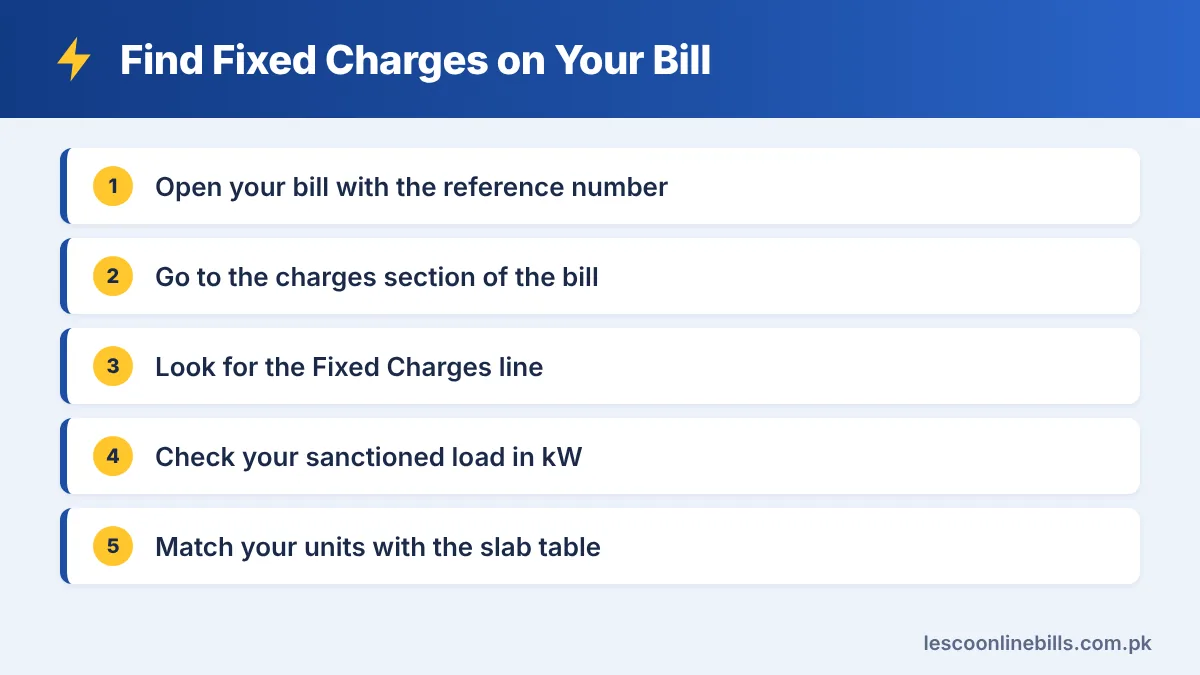
Every LESCO bill lists its charges in a separate section. To find your fixed charge:
- Open your latest bill with your 14-digit reference number on our bill check page or the official portal.
- Go to the section that lists the electricity cost, adjustments and taxes.
- Look for the line called Fixed Charges.
- Check your sanctioned load and units consumed on the same bill.
- Compare the amount with the slab table above.
If you do not have your reference number, our LESCO reference number guide shows how to find it. You can also view an online copy with the LESCO web bill.
LESCO Fixed Charges vs Other Bill Charges
Fixed charges are only one part of your bill. It helps to know how they differ from the other lines:
| Charge | What it is | Changes with units? |
|---|---|---|
| Fixed charges | Monthly amount based on slab, status and sanctioned load | Only when you change slab |
| Cost of electricity | Units used multiplied by the unit rate | Yes |
| FPA / FCA | Monthly fuel cost adjustment | Yes |
| QTA | Quarterly tariff adjustment | Yes |
| Taxes | GST and other taxes on the taxable amount | Yes |
Read more about the monthly fuel adjustment in our LESCO FPA charges guide and about every tax line in LESCO bill taxes. Current per-unit prices are on our LESCO unit rate page.
Protected vs Unprotected: Why It Matters for Fixed Charges
Protected status is one of the biggest factors in your LESCO fixed charges. A domestic consumer who uses 200 units or fewer for six months in a row is treated as protected. Protected users get lower unit rates and the lowest fixed charge rates.
If you go above 200 units even once, you can lose protected status for the next six months. That means higher unit rates and higher LESCO fixed charges, even if your use drops again the next month. Our LESCO bill subsidy guide explains protected status and relief in detail.
For many families, staying protected is the single best way to keep the whole bill, including fixed charges, under control.
7 Ways to Pay Less in LESCO Fixed Charges
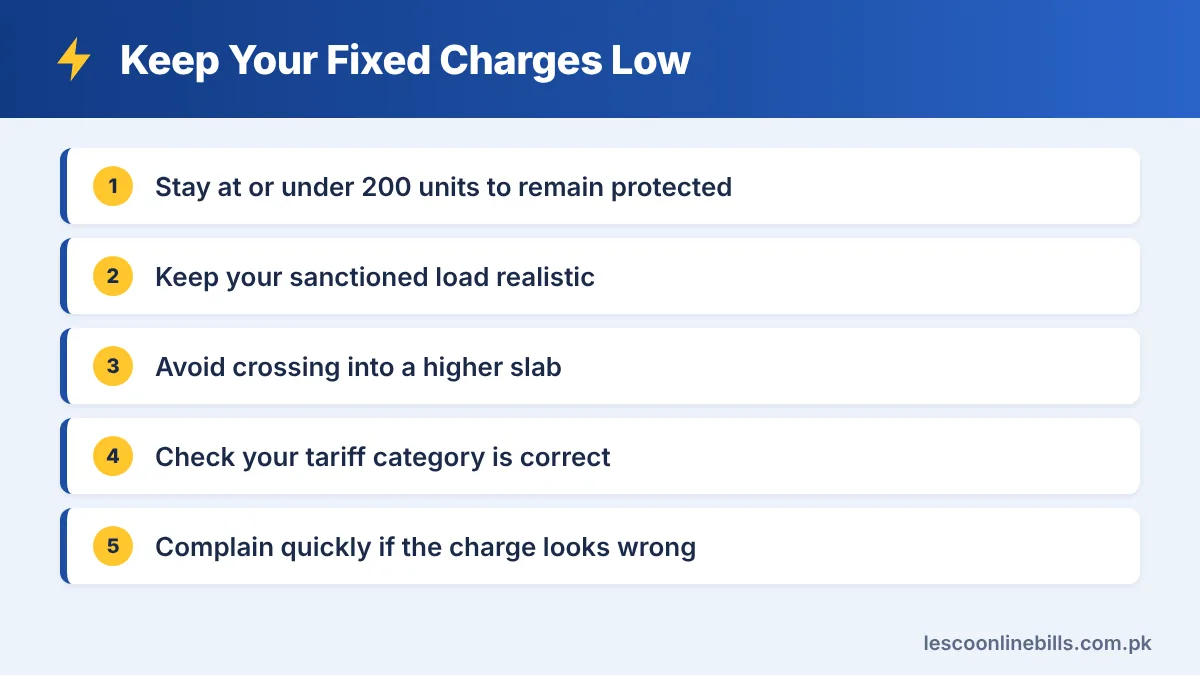
- Stay at or under 200 units each month to keep protected status and the lowest rate.
- Watch slab borders: 100, 200, 300, 400 and 500 units. Crossing one moves you to a higher fixed charge rate.
- Keep your sanctioned load realistic. If it is much higher than your real use, ask your sub-division about the correct procedure for load reduction.
- Check your tariff category. A home wrongly billed as commercial pays very different charges.
- Read your meter mid-month so you can cut use before you cross a slab. See our LESCO meter reading guide.
- Use heavy appliances outside peak hours if you have a time-of-use meter. See LESCO peak hours.
- Estimate before the bill arrives with our LESCO bill calculator.
Is Your LESCO Fixed Charge Wrong? How to Check
Mistakes happen. A wrong reading, wrong sanctioned load or wrong tariff category can all inflate LESCO fixed charges. Check these points on your bill:
- Is the tariff shown as domestic (A-1) for a home?
- Is the sanctioned load the same as on your earlier bills and connection papers?
- Do the units match the reading on your meter?
- Does your protected or unprotected status match your last six months of use?
If something does not match, apply for a correction at your sub-division with a copy of the bill and a photo of your meter. Our LESCO bill correction guide explains the process, and you can also file a LESCO complaint online or by calling 118.
LESCO Fixed Charges for Solar and Time-of-Use Users
Homes with time-of-use (TOU) meters and many solar users are billed under different tariff entries, so the domestic slab table may not apply to them directly. Net-metering customers should check how fixed charges appear on their import and export bills, as rules for solar have also been under review. Our LESCO net metering guide covers solar billing.
If your bill shows a TOU tariff, compare its fixed charge with your earlier bills and ask your sub-division if anything is unclear.
LESCO Fixed Charges for Shops, Offices and Tenants
The slab table above is for domestic homes. Shops, offices and other commercial connections are billed under commercial tariffs, which have their own rates and conditions. If you run a small shop from a residential meter, your bill may be changed to a commercial category after a site check, which can raise both the unit rate and the fixed charge. Ask your sub-division before using a home meter for business.
Tenants should also understand LESCO fixed charges. The fixed charge follows the connection, not the person, so a tenant pays whatever the bill shows for that meter. If two families share one meter, their combined units can push the bill into a higher slab and a higher fixed charge rate. Separate meters, where allowed, often keep each household in a lower slab.
Month-by-Month: How to Track Your Fixed Charges
A simple habit helps you spot changes early. Keep a small table in your phone notes with four columns: month, units, status (protected or unprotected) and the Fixed Charges amount. After three or four months, you will see a clear pattern.
If the fixed charge jumps while your units and status stay the same, check whether your sanctioned load or tariff changed on the bill. If it rises because your units crossed a slab, you know exactly which month to watch next year, especially in summer when fans, coolers and ACs push use higher. You can also open older bills on our LESCO previous bill page to compare.
Common Myths About LESCO Fixed Charges
- “Fixed charges are only for big houses.” Not anymore. Since 2026, most domestic consumers pay them, including protected users.
- “If I use zero units, I pay nothing.” Fixed charges still apply when a connection is active, which is why they are called fixed.
- “LESCO sets the rate by itself.” The rates come from NEPRA’s national tariff schedule, not a LESCO-only decision.
- “Fixed charges are the same for everyone.” They depend on your slab, status and sanctioned load, so neighbours can pay different amounts.
What to Do If You Cannot Pay Your Bill
If higher fixed charges have pushed your bill beyond your budget, do not ignore it. Late payment adds a surcharge and can lead to disconnection. You can ask for installments at your sub-division; see our LESCO bill installment guide. Check the last date to pay on our LESCO bill due date page, and pay online through the methods in LESCO online bill payment.
How to Explain Fixed Charges to Your Family
Many families argue about the bill without knowing why it rose. A simple way to explain LESCO fixed charges at home is this: “We now pay a small monthly fee to stay connected, and that fee goes up if we use more units or keep a bigger load.” Once everyone understands that crossing 200 units costs more in both unit rates and fixed charges, it becomes easier to agree on using the AC, iron and water pump more carefully.
Children and elders can help too: switching off lights in empty rooms and running the washing machine only with a full load all add up over a month. Put a note near your meter with the units you have used so far this month. When the family can see the number, they are far more likely to help keep the bill in a lower slab.
LESCO Fixed Charges Checklist
- Know your sanctioned load in kW.
- Know whether you are protected or unprotected.
- Track your units in the middle of the month.
- Stay below slab borders when possible.
- Compare each bill’s Fixed Charges line with the table.
- Report errors quickly with photos and copies.
LESCO Fixed Charges FAQs
What are LESCO fixed charges?
They are a fixed monthly amount on your bill that you pay in addition to the cost of the units you use. For most homes they depend on your consumption slab, your protected or unprotected status and your sanctioned load.
How much are LESCO fixed charges in 2026?
Under the February 2026 schedule, domestic fixed charges range from Rs200 to Rs675 per kW of sanctioned load per month. Protected users pay Rs200 or Rs300, while unprotected users pay from Rs275 up to Rs675 depending on units used.
Do protected consumers pay fixed charges?
Yes. Under the 2026 restructuring, protected domestic consumers also pay fixed charges: Rs200 per kW for up to 100 units and Rs300 per kW for 101 to 200 units. Lifeline consumers are excluded.
Why did my LESCO fixed charges increase?
Your units may have moved you into a higher slab, you may have lost protected status, or your sanctioned load may be higher than before. Compare this month’s bill with the previous one to see which changed.
Can I reduce my LESCO fixed charges?
Yes. Keep your monthly units in a lower slab, stay protected by using 200 units or fewer, and make sure your sanctioned load is not higher than you need. If the charge is wrong, ask for a bill correction.
Are taxes charged on fixed charges?
Taxes are worked out on the bill’s taxable amount, which can include fixed charges. The exact tax lines depend on your category and filer status, so check the tax section of your bill.
Final Words
LESCO fixed charges are now a regular part of almost every home’s bill. Under the 2026 schedule they range from Rs200 to Rs675 per kW of sanctioned load, depending on your units and protected status. You cannot remove them completely, but you can keep them low by staying protected, watching slab borders, keeping your sanctioned load accurate and checking every bill for mistakes. Open your bill today, find the Fixed Charges line and see where you stand.