LESCO Net Metering 2026: New Net Billing Rules, Online Apply and Bill Guide
LESCO net metering has changed more in 2026 than in the past ten years. If you are planning rooftop solar in Lahore, Kasur, Okara, Sheikhupura or Nankana Sahib, or you already have a green meter, the rules you read about last year may no longer apply. New applicants now come under net billing, while older users keep their original terms for now.
This guide explains what LESCO net metering means today, what the NEPRA Prosumer Regulations 2026 changed, how to apply on the PITC portal, which documents you need, what it costs and how to read your solar bill. Every section is written for home and small business users, not engineers.
Table of Contents
What Is LESCO Net Metering?
LESCO net metering is the arrangement that lets a solar user connect to the LESCO grid and exchange electricity in both directions. During the day your panels may produce more power than you use, and the surplus flows to the grid. At night you import power from LESCO as usual. A special two-way meter records both flows.
Under the 2015 rules, exported units were simply subtracted from imported units, so one exported unit cancelled one imported unit. That is why many households saw very small bills after installing solar. LESCO is the largest solar market among the distribution companies, with about 2,053 MW of LESCO net metering capacity and more than 135,000 active connections reported in May 2026.
Net metering vs net billing
The new system works differently. Under net billing, the units you import are charged at your normal tariff, while the units you export are bought at a lower rate. Your bill shows both values, and any surplus credit is carried to the next bill or settled periodically. In short, export is no longer worth the same as import.
| Point | Old LESCO net metering (2015 rules) | Net billing (2026 rules) |
|---|---|---|
| Export value | Offset against imports, close to retail rate | National average energy purchase price |
| Import charge | Net units only | All imported units at normal tariff |
| Agreement term | 7 years | 5 years |
| Max solar size | Up to 1.5 times sanctioned load | Equal to sanctioned load (1:1), up to 1 MW |
| Applies to | Users approved before 9 Feb 2026 | New applicants |
What Changed in 2026: The NEPRA Prosumer Regulations
NEPRA notified the Prosumer Regulations 2026 on 9 February 2026. They replaced the 2015 net metering regulations for new cases. The main changes for anyone considering LESCO net metering are:
- Lower export rate: exported units are bought at the national average energy purchase price. Reports in 2026 placed this around Rs9 to Rs13 per unit, far below the earlier Rs25 to Rs27 range.
- Shorter agreements: new agreements run for five years instead of seven.
- Size cap: solar capacity cannot be more than your sanctioned load.
- Transformer limit: no new solar connection is allowed on a transformer once solar there reaches 80 percent of its capacity.
- Fixed deadlines: acknowledgement in 5 working days, technical review in 15 days and interconnection within 15 days of payment.
In August 2026, SRO 1330(I)/2026 removed the need for NEPRA concurrence for systems up to 25 kW, so the distribution company now approves these smaller cases itself. News reports also said the NEPRA fee was dropped for systems up to 25 kW, while larger systems still pay it. You can read the official notification on the NEPRA website.
Are Existing LESCO Net Metering Users Affected?
If you were approved before the new rules, your LESCO net metering agreement continues on its original terms until it expires. After public concern in February 2026, the government said applications filed up to 8 February 2026 would also be processed under the old rules.
On 24 February 2026, the Lahore High Court directed distribution companies, including LESCO, to bill consumers approved by 9 February 2026 under the 2015 regulations. Around 1,204 LESCO applications filed before that date were moved to the PITC portal for processing.
Some changes still reached existing users. LESCO reduced its export rate for older users slightly from the January 2026 billing month, and exports above the approved capacity are capped. If your agreement is close to expiry, ask your sub-division in writing what terms will apply on renewal.
Who Can Apply for LESCO Net Metering?
Any LESCO consumer with a three-phase or single-phase connection can apply, provided a few conditions are met:
- The connection is in your name, or you have the owner’s consent and documents.
- There are no arrears, deferred amounts or pending installments on the bill.
- Your planned solar size is equal to or less than your sanctioned load.
- The local transformer has not reached its 80 percent solar limit.
- Your inverter and panels are installed by an installer certified by the Alternative Energy Development Board (AEDB).
If the bill is still in a previous owner’s name, complete the name change first. If your load is too low for the system you want, apply for a load extension before you file. Both steps save weeks of back-and-forth later.
How to Apply for LESCO Net Metering Online
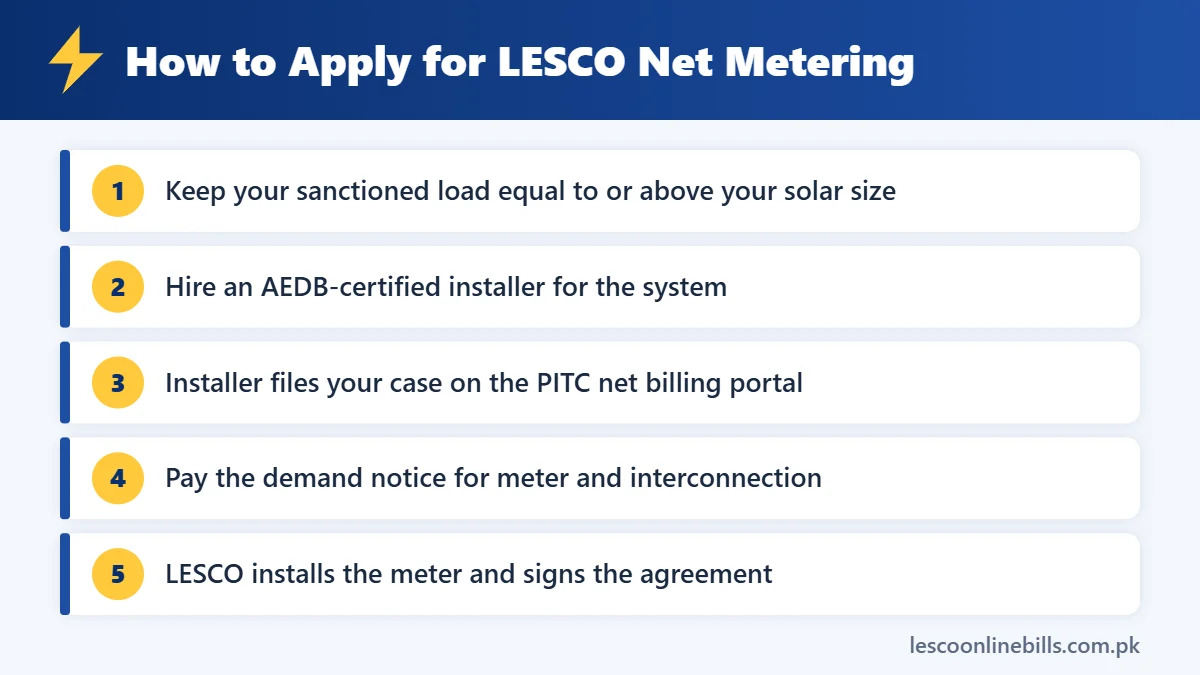
All distribution companies, including LESCO, now use the PITC net billing portal at nmp.pitc.com.pk. In most cases your installer files the application, but you can also start it yourself. Here is the usual process:
- Check your sanctioned load: it is printed on your bill. Your solar capacity must not exceed it.
- Choose a certified installer: pick an AEDB-certified company and get a written quotation that includes the meter and paperwork.
- Install the system: the installer sets up panels, inverter and protection devices to the required standards.
- File the application: on the portal, select Net Billing (by consumer or by installer), enter your reference number and upload the forms.
- Technical review: LESCO checks the site, the transformer capacity and your documents.
- Pay the demand notice: this covers the meter and interconnection costs.
- Meter installation and agreement: LESCO installs the meter, signs the agreement and your LESCO net metering (net billing) connection goes live.
Documents Required for LESCO Net Metering
The portal asks for a set of standard forms, mostly prepared and uploaded by the installer. Keep copies of everything:
- DISCO interconnection agreement (NEPRA Schedule I) and NEPRA Schedules II to V.
- Installer and customer agreement (AEDB Schedules III and IV).
- Undertaking to follow technical standards.
- AEDB inspection form for the installed system.
- Copy of your CNIC and latest paid electricity bill.
- Inverter and panel details, including the inverter serial number and maker.
The inverter details matter. LESCO checks that the inverter serial number and manufacturer match its records before the meter is approved, and a mismatch is a common reason for delays.
Fees, Meter Cost and Approval Timeline
The total cost of LESCO net metering has three parts: your solar system, the meter and interconnection charges, and any regulator fee. Exact meter prices have changed several times, so treat the figures below as a guide and confirm the amount on your demand notice.
| Item | What to expect |
|---|---|
| Meter | LESCO now installs smart AMI/AMR meters for solar users. A fee of about Rs70,000 was reported in September 2025. |
| NEPRA fee | Reported as waived up to 25 kW; Rs1,000 per kW still reported above 25 kW. |
| Acknowledgement | Within 5 working days of a complete application |
| Technical review | Within 15 days |
| Interconnection | Within 15 days of paying the demand notice |
LESCO stopped buying the old green bidirectional meters in 2025 and moved to smart meters that send readings to its control room. This makes remote reading possible and reduces disputes over export units.
How to Track Your LESCO Net Metering Application
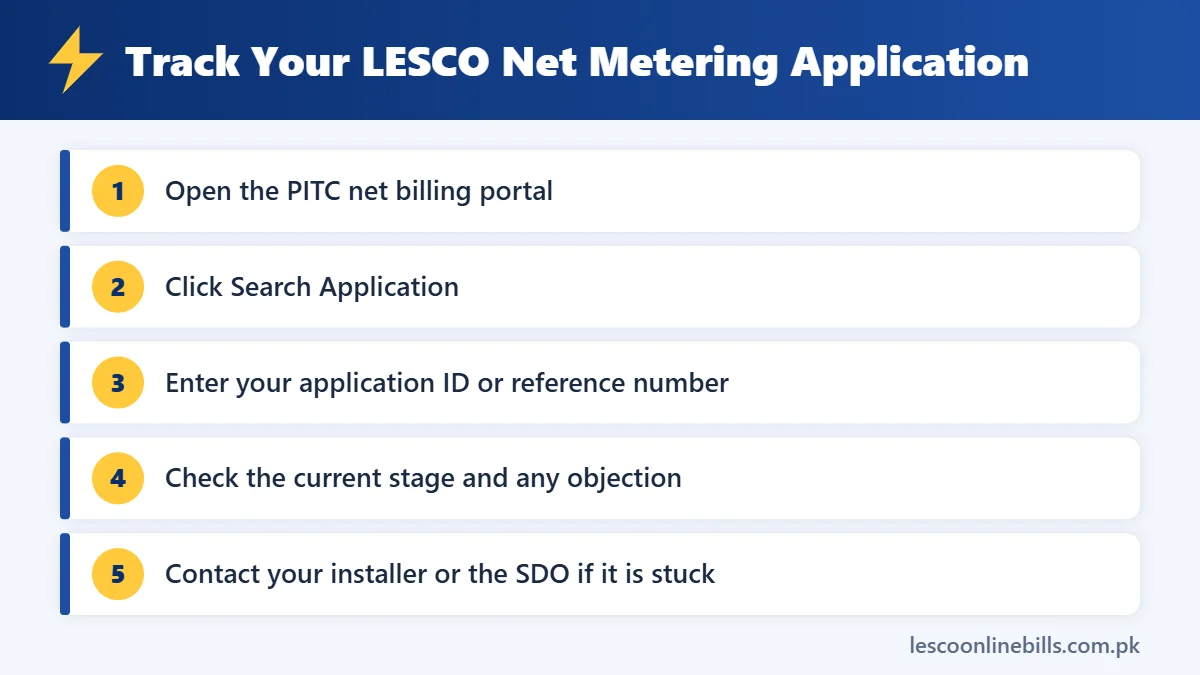
Once your case is filed, you can follow it online:
- Open the PITC net billing portal.
- Click Search Application.
- Enter your application ID or reference number.
- Check the stage, such as document review, technical review, demand notice or meter installation.
Older cases filed before the new rules can be checked on the PITC verification portal. In September 2026, more than 11,000 of about 16,600 pending cases across the country were reported as cleared. If your LESCO net metering case has not moved for several weeks, write to the portal support email and ask your installer to follow up with the sub-division.
How to Read a LESCO Net Metering Bill
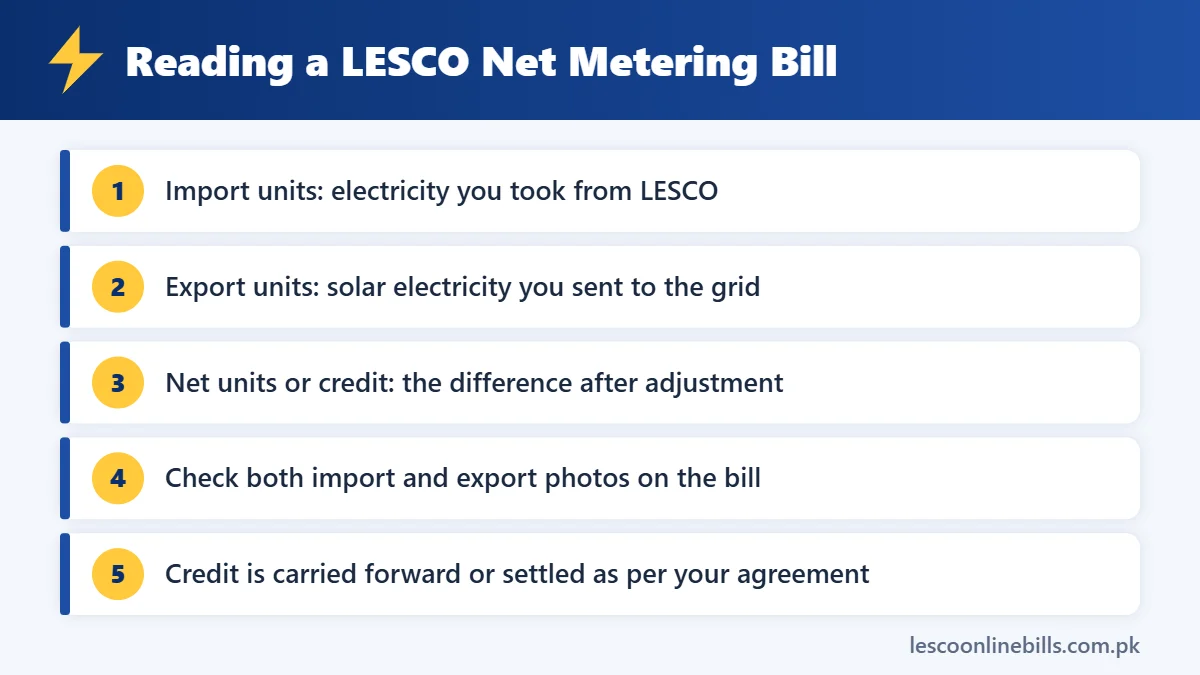
A solar bill looks a little different from a normal bill. You will see import and export values and, often, two meter photos. Here is what to check every month:
- Import units: electricity you used from LESCO, mostly at night.
- Export units: solar electricity sent to the grid.
- Peak and off-peak split: shown when you have a time-of-use meter.
- Net amount or credit: the result after your export value is adjusted.
Check both readings the same way you would check a normal bill. Our LESCO meter reading guide explains how to read the display, and the LESCO peak hours page shows when peak rates apply. In January 2026, some LESCO solar bills were reprinted because export units had been left out, so never assume the first bill is correct.
Example: How Net Billing Changes a Monthly Bill
Numbers make the change easier to understand. The example below is only an illustration. It assumes a home that imports 400 units from the grid and exports 300 solar units in one month, with an export rate of Rs11 per unit. Your real tariff, taxes and export rate will differ, so always use the values on your own bill.
| Item | Old LESCO net metering | Net billing |
|---|---|---|
| Units imported | 400 | 400 |
| Units exported | 300 | 300 |
| Units billed at tariff | 100 (400 minus 300) | 400 |
| Export credit | Already offset in units | 300 x Rs11 = Rs3,300 |
Under the old method, the home paid for only 100 units. Under net billing, it pays for all 400 imported units and then receives a credit for the 300 exported units. Because imported units cost much more than the export rate, the final bill is higher than before, even though the solar system produces the same power.
The lesson is simple. Each unit of solar power you use yourself saves you the full tariff, while each unit you export earns only the lower export rate. That is why daytime use, smart scheduling and correct system sizing now matter more than they did under the original LESCO net metering rules.
Quick checklist before you invest
- Get at least two quotations from AEDB-certified installers.
- Ask for a payback estimate based on the current export rate.
- Confirm the meter cost and who pays the demand notice.
- Check that your sanctioned load and name are correct on the bill.
- Keep copies of all forms, receipts and the signed agreement.
Common LESCO Net Metering Problems and Fixes
- Export units missing: take photos of the export register and file a complaint on 118. See our LESCO complaint guide for every channel.
- Application stuck: check for objections on the portal; most delays come from missing forms or inverter mismatch.
- Transformer full: if your transformer has reached its solar limit, ask the sub-division whether an upgrade is planned.
- Name or load mismatch: correct the name and sanctioned load first, then re-apply.
- Unexpected high bill: compare import and export with your own readings and check the taxes section using our LESCO bill taxes guide.
Is Solar Still Worth It for LESCO Consumers?
Solar still makes sense for many homes, but the maths has changed. Under net billing, the best savings come from using your solar power directly during the day rather than exporting it. Run pumps, washing machines, irons and air conditioners while the sun is up.
Some users add a battery to store daytime power for the evening peak. Others size the system closer to their daytime load so less power is exported at the low rate. Ask your installer for a payback estimate that uses the current export rate, not the old LESCO net metering rate.
If you are a small consumer who uses less than 200 units, compare the cost of solar with the savings from protected rates. Our LESCO bill subsidy guide and the LESCO unit rate page help you see where you stand.
LESCO Net Metering FAQs
Has LESCO net metering ended in 2026?
For new applicants, net metering has been replaced by net billing under the NEPRA Prosumer Regulations 2026, notified on 9 February 2026. Consumers already approved under the old rules continue on their existing terms until their agreements expire.
What is the buyback rate under net billing?
Exported units are bought at the national average energy purchase price instead of the full retail tariff. News reports in 2026 put this at roughly Rs9 to Rs13 per unit, so check the export rate printed on your own bill for the exact figure.
How do I apply for LESCO net metering online?
Applications are filed on the PITC net billing portal at nmp.pitc.com.pk, usually by your AEDB-certified installer. You can also apply as a consumer, upload the required forms and then track the case with the Search Application option.
How long does LESCO net metering approval take?
The 2026 regulations set short deadlines: acknowledgement within 5 working days, technical review within 15 days and interconnection within 15 days of payment. Real cases can take longer if documents are incomplete or the local transformer is near its solar limit.
Do I need a NEPRA licence for a 10 kW system?
Under SRO 1330(I)/2026 issued in August 2026, systems up to 25 kW no longer need NEPRA concurrence and are approved by the distribution company. Larger systems still go through NEPRA.
Can I install solar larger than my sanctioned load?
No. Under the 2026 rules your solar capacity cannot exceed your sanctioned load. If you want a bigger system, apply for a load extension first and then file the net billing application.
Final Words
LESCO net metering in 2026 is really net billing for anyone applying now. Existing users keep their old terms until their agreements end, while new users get a lower export rate, a five-year agreement and a solar size capped at sanctioned load. Apply through a certified installer on the PITC portal, keep your documents complete and check every bill for both import and export units. To review your latest bill, use our LESCO bill check online tool.