LESCO Bill for Tenants: Rights, Payments and How to Avoid Disputes
Renting a house or portion in Lahore, Kasur, Okara or Sheikhupura? Electricity is often the biggest monthly cost after rent, and it is also the biggest cause of arguments between tenants and owners. Understanding the LESCO bill for tenants before you sign can save you money and stress.
This guide covers who is responsible for the bill, what to check before renting, how to handle shared meters, arrears and detection bills, and a simple checklist for moving in and out. You can check any bill instantly on our LESCO bill check page with the reference number.
Table of Contents
Who Is Responsible for the LESCO Bill for Tenants?
LESCO connections are usually registered in the property owner’s name. In LESCO’s records, the owner is the account holder. But LESCO does not decide who pays inside a rental arrangement; your rent agreement does.
In most rentals, the tenant pays the LESCO bill for the months they live in the property, and the owner remains responsible for the connection itself. Problems start when the agreement says nothing clear about electricity, so make the LESCO bill for tenants part of your written agreement.
9 Simple Rules for the LESCO Bill for Tenants
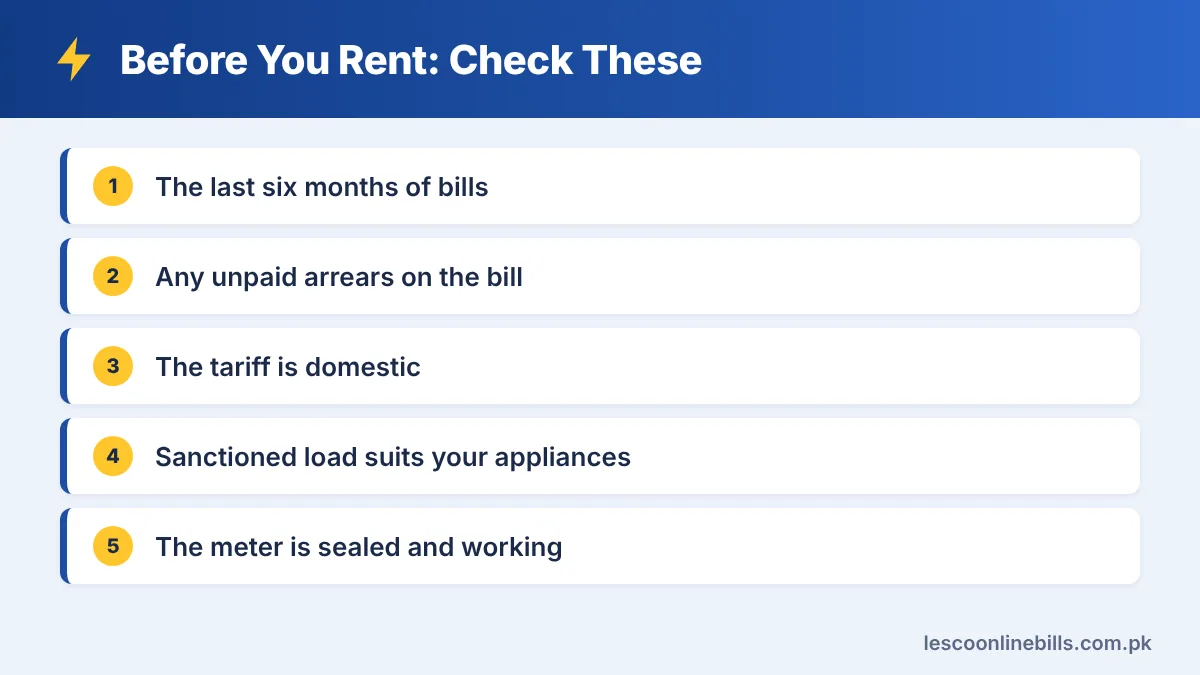
- Check the last six months of bills before you agree to rent.
- Make sure there are no unpaid arrears, or agree in writing who clears them.
- Check that the tariff is domestic for a home.
- Check that the sanctioned load suits your appliances.
- Take a dated photo of the meter reading on the move-in day.
- Write in the agreement who pays the bill and by which date.
- Agree on how shared meters will be split, if any.
- Keep every paid bill or payment receipt.
- Take a final meter photo and settle the last bill when you leave.
LESCO Bill for Tenants: Check the Bill History Before You Rent
The bill history tells you a lot about a property. Ask the owner for the 14-digit reference number and open the last few bills online. Look for:
- Arrears: any unpaid amount carried forward from earlier months.
- Units used: high units may mean an inefficient house, faulty wiring or old appliances.
- Tariff: a commercial tariff on a home costs much more.
- Sanctioned load: too low means tripping; too high can mean higher fixed charges.
- Detection or adjustment charges: these can signal past disputes.
You can see past bills with our LESCO previous bill guide and check payments with LESCO bill paid or not.
Old Arrears: Do Not Pay for Someone Else’s Electricity
Unpaid bills stay with the connection, not with the previous tenant. If you move into a house with arrears, the next bill will include them, and LESCO can disconnect the supply if they are not paid. That is why arrears are one of the biggest issues in the LESCO bill for tenants.
Agree before moving in that the owner will clear the arrears, or that the amount will be deducted from rent. Put it in writing. If arrears appear after you move in, show the owner the earlier bills as proof that the amount is from before your tenancy.
Write Electricity Into Your Rent Agreement
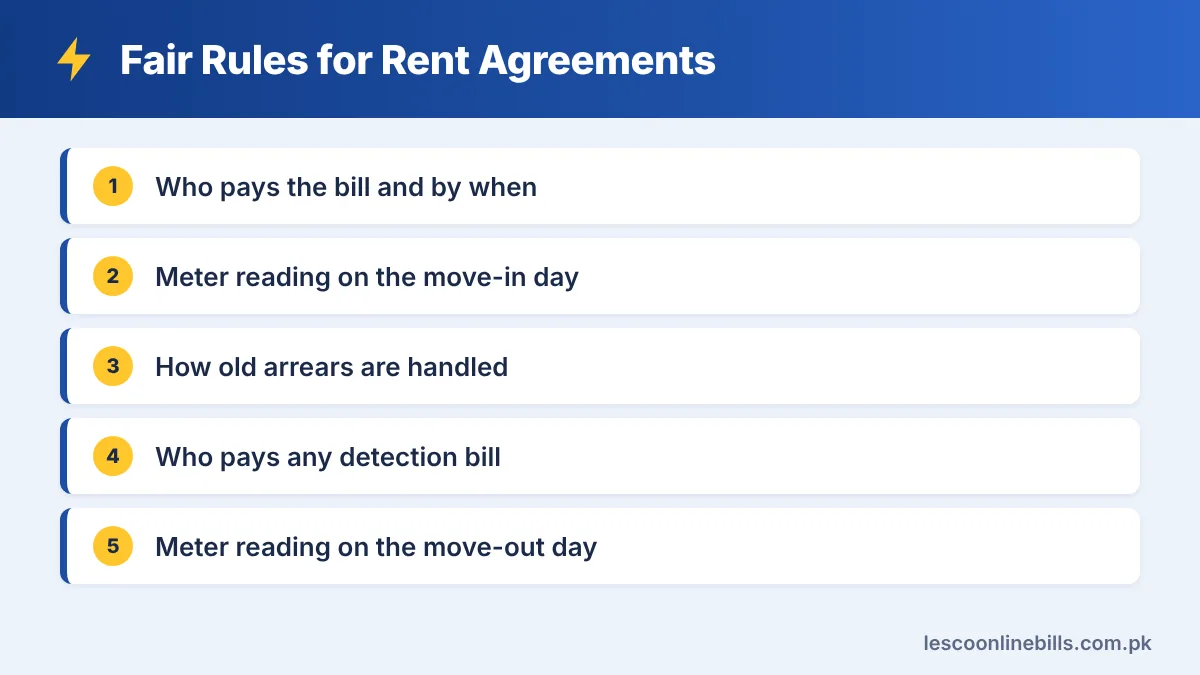
A good rent agreement avoids most disputes. Add a short electricity section that covers:
| Point | What to write |
|---|---|
| Who pays | Tenant pays LESCO bills from the move-in date to the move-out date |
| Payment deadline | Before the due date shown on each bill |
| Starting reading | Meter reading and date on move-in day, with a photo |
| Old arrears | Owner clears all dues before the tenancy starts |
| Detection bills | Who pays, depending on which period the charge relates to |
| Final reading | Meter reading and date on move-out day |
Shared Meters and the LESCO Bill for Tenants
Many houses in Lahore have two or three portions on one meter, which makes the LESCO bill for tenants harder to split. This creates two problems. First, combined use quickly crosses 200 units, so everyone loses protected rates and pays higher fixed charges. Second, families argue about who used how much.
If you must share a meter:
- Agree on a fair split in writing, for example by number of rooms or ACs.
- Read the meter on the same date each month and share a photo in a family group.
- Remember that slabs make the last units more expensive than the first.
- Talk about heavy appliances, such as ACs and water heaters, before summer.
A private sub-meter can help divide the bill inside the house, but it is not a LESCO meter and does not change how LESCO bills the main connection. In many cases, a separate LESCO meter for each portion is fairer and cheaper in the long run. Costs are explained in our LESCO meter price guide, and the owner normally needs to apply.
Protected Status and Fixed Charges for Tenants
Tenants often do not realise that the slab system affects the LESCO bill for tenants directly. If your use stays at or under 200 units for six months, the connection can be treated as protected, with lower rates and the lowest fixed charges. One heavy month can end that for half a year.
Since 2026, domestic fixed charges are also linked to the sanctioned load. Read our LESCO fixed charges and LESCO sanctioned load guides to understand how they affect the LESCO bill for tenants.
Name Change, Load Change and Other Requests
Some LESCO services can only be requested by the account holder, usually the owner, because they need ownership documents. These include:
- Change of name on the connection (see LESCO change of name).
- Load extension or reduction.
- Meter shifting.
- Permanent disconnection and security refund.
Tenants can still pay bills, check bills online, register for SMS alerts with their own number if the owner agrees, and report faults and outages using the reference number.
What If You Get a Detection Bill as a Tenant?
A detection bill is the most serious surprise in any LESCO bill for tenants. It charges for electricity LESCO believes was used but not billed, for example because of a faulty or tampered meter. It can be large, and it may cover months before you moved in. Check which period the detection relates to, collect your move-in meter photo and rent agreement, and talk to the owner immediately.
If the detection is wrong, the account holder can object with evidence. Our LESCO detection bill guide explains your rights and how to challenge it. Never pay someone to “settle” a detection informally.
Wrong LESCO Bill for Tenants: What to Do
If you receive a bill that does not match the meter, take a dated photo of the meter, keep the bill and report it. A tenant can call 118 or file a complaint with the reference number, and the owner can apply for a correction at the sub-division. See LESCO bill correction and LESCO complaint.
Paying the LESCO Bill for Tenants
You can pay the LESCO bill for tenants the same way as any consumer: at banks, through banking apps, mobile wallets and other official channels. Save every receipt or screenshot. If you pay the owner instead of LESCO, ask for proof that the bill was paid on time; unpaid bills can lead to surcharges and disconnection while you are living there. If a bill is too high to pay at once, the owner can ask about installments; see LESCO bill installment.
Moving Out: Settle the LESCO Bill for Tenants Cleanly
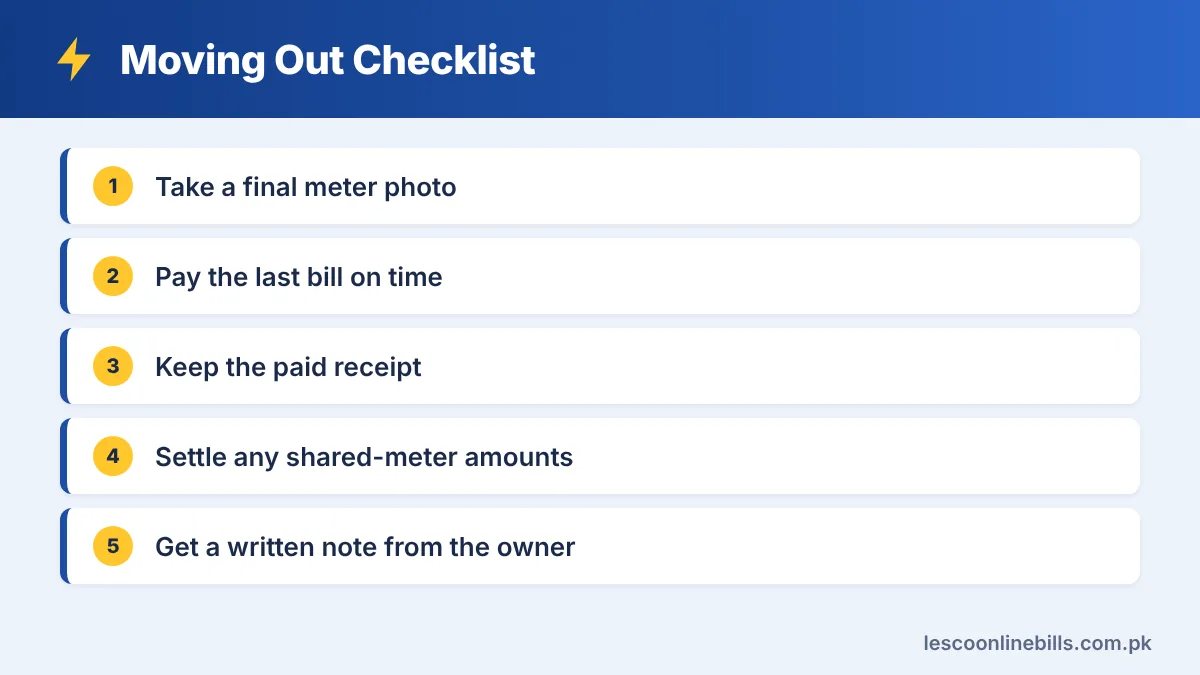
- Take a dated photo of the meter reading on your last day.
- Pay the latest bill before the due date.
- Agree with the owner on the amount for the days after the last bill.
- Settle any shared-meter amounts with other families.
- Get a written or WhatsApp note from the owner that electricity dues are clear.
- Keep copies of your last bills for a few months.
If the owner keeps your security deposit for electricity, ask for a clear calculation based on the meter readings. Download a LESCO duplicate bill if you need a copy as proof.
LESCO Bill for Tenants When the Owner Lives Abroad
Many owners in Lahore live overseas and rent out their homes through relatives or agents. This can make the LESCO bill for tenants harder to manage, because requests like a meter change or bill correction may need the owner’s signature. Before you rent, ask who will act for the owner, get their phone number and agree how urgent electricity issues will be handled. Keep a scanned copy of the owner’s CNIC and authority letter, if they provide one, so the representative can sign applications at the sub-division when needed.
When the Power Is Disconnected
If your supply is cut because of unpaid bills from before your tenancy, contact the owner at once and show them the bill history. Reconnection needs the dues to be cleared and may carry a fee; see our guide to the LESCO reconnection fee. If the cut is due to a fault rather than non-payment, call 118 and report it with the reference number.
Tips for Owners Renting Out Property
- Clear all arrears before a new tenant moves in.
- Keep the meter sealed and in good condition.
- Consider separate meters for separate portions.
- Give tenants the reference number so they can check and pay bills.
- Write clear electricity rules into the agreement.
Save Money as a Tenant
Even if the house is not yours, you control how much electricity you use. Set ACs to around 26°C with a fan, use LED bulbs, run the water pump at sensible times and read the meter in the middle of the month. Our reduce LESCO bill guide has 15 practical ideas that work just as well for tenants as for owners.
Common Disputes and How to Avoid Them
| Dispute | How to avoid it |
|---|---|
| Old arrears on the first bill | Check bills before renting and agree in writing |
| Shared meter split | Fixed reading dates and a written split |
| Final bill after leaving | Move-out photo and agreed final amount |
| Detection bill | Move-in photo and clear agreement on periods |
| Late payment surcharge | Pay before the due date and keep receipts |
Sample Electricity Clause for a Rent Agreement
You can adapt this simple clause for your own agreement. It is not legal advice, but it covers the points that cause most problems with the LESCO bill for tenants:
Both parties should sign the agreement and keep a copy, together with the photos of the meter readings.
Students and Hostel Rooms
Students sharing a house or renting rooms in a hostel often split one bill among many people. Agree on the split before the first bill arrives, and remember that a single AC running all night in one room can double the units for everyone. A simple rule, such as each AC room paying a fixed extra share, keeps things fair and friendly.
LESCO Bill for Tenants in Shops and Offices
Commercial tenants face the same issues with a few extras. Shops and offices are billed on commercial tariffs, so every unit costs more, and some larger connections have extra charges linked to maximum demand. Before renting a shop, check that the tariff and sanctioned load on the bill suit your business. If you plan to run heavy machines, ACs or freezers, make sure the connection can handle them, because a load change will need the owner’s application. Write the LESCO bill for tenants rules into the shop rent agreement just as you would for a house.
Keep Records Throughout Your Tenancy
Good records protect tenants. Keep a simple folder or phone album with your move-in meter photo, every paid bill or receipt, a monthly meter photo and any messages with the owner about electricity. If there is ever a dispute about the LESCO bill for tenants, these records settle it quickly and fairly. They also help you notice a fast or faulty meter early, because you can compare your monthly readings with the bills.
LESCO Bill for Tenants: Quick Checklist
- Reference number saved.
- Last six bills checked for arrears, tariff and load.
- Move-in meter photo taken with date.
- Electricity clause signed in the rent agreement.
- Shared-meter split agreed in writing.
- Bills paid before the due date, receipts kept.
- Move-out meter photo and final settlement in writing.
LESCO Bill for Tenants FAQs
Who is responsible for the LESCO bill, the owner or the tenant?
The connection is usually in the owner’s name, so LESCO treats the owner as the account holder. Who actually pays is decided by the rent agreement. Most agreements make the tenant pay the bills for the time they live in the house.
Do I have to pay old arrears as a new tenant?
Arrears belong to the period before you moved in, so they should be settled between you and the owner, ideally before you move in. Check the bill for arrears and agree in writing who will clear them.
Can a tenant change the name on a LESCO bill?
A change of name usually needs ownership documents, so it is normally done by the owner. Tenants can still pay bills, check them online and report supply problems using the reference number.
Can a tenant file a complaint with LESCO?
Yes. A tenant can report faults, outages and billing problems with the reference number. For changes such as load extension, meter shifting or a name change, the owner usually needs to apply or give written consent.
How should two families share one meter?
Agree on a fair split in writing, and take meter readings on fixed dates. Remember that combined use can push the bill into a higher slab. A separate meter for each portion often costs less in the long run.
What should I do when moving out?
Take a dated photo of the meter, pay the final bill or agree on the amount for the last days, keep the paid receipt and get a written note from the owner that electricity dues are settled.
Final Words
The LESCO bill for tenants does not have to cause stress. Check the bill history before renting, agree in writing who pays and how arrears and shared meters are handled, take dated meter photos at move-in and move-out, and pay every bill on time with receipts. Most disputes disappear when both sides know the numbers and have them in writing.