LESCO Detection Bill 2026: NEPRA Rules, Time Limits and How to Challenge It
A LESCO detection bill can arrive as a shock: a separate bill for hundreds or thousands of units you do not remember using. Sometimes it is justified, for example after proven tampering. Other times it is issued without notice, for too many months or on the wrong basis. Either way, you have clear rights under NEPRA rules, and new 2026 orders have made the process stricter.
This guide explains what a LESCO detection bill is, how units are calculated, how many months can be charged, what changed in October 2026 and how to challenge a wrong bill step by step. It is meant to help ordinary consumers understand the rules and protect themselves.
Table of Contents
What Is a LESCO Detection Bill?
A LESCO detection bill is a charge for electricity that the company believes was consumed but not billed. It is covered in Chapter 9 of the NEPRA Consumer Service Manual, which deals with theft and illegal abstraction of electricity. Typical reasons include direct hooking from the line, a bypassed meter, tampered seals, a slowed meter or a meter manipulated with software or other devices.
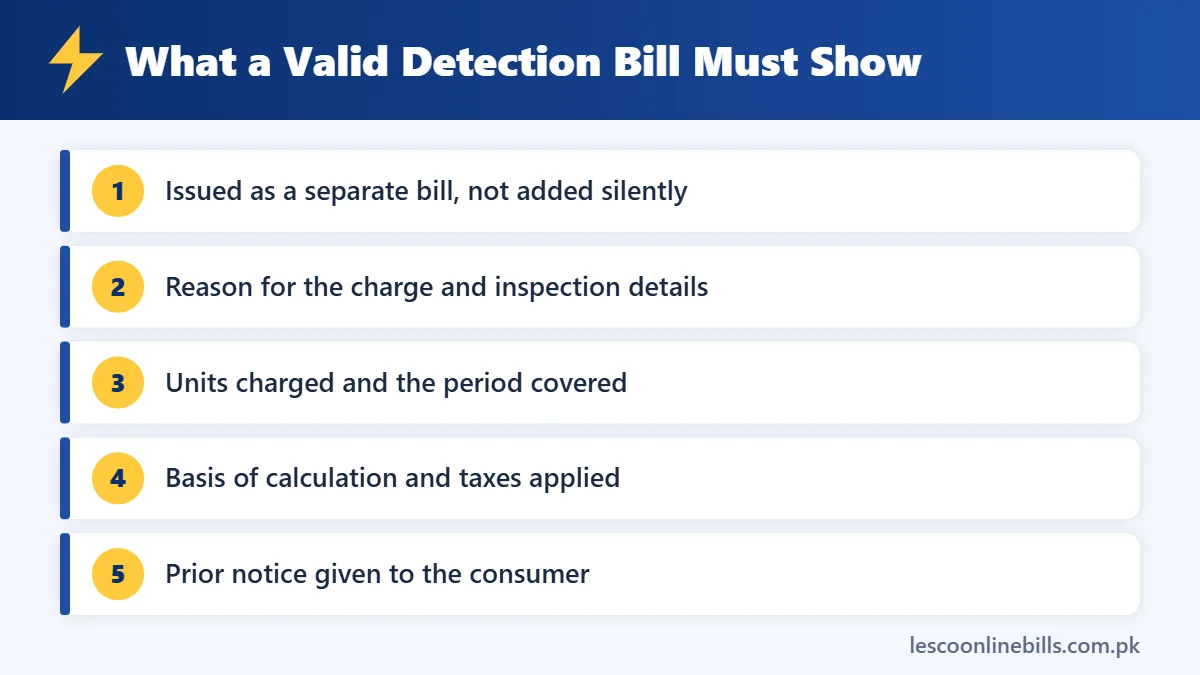
The bill is different from a normal monthly bill. Since a 2023 amendment to the manual, a detection bill must be issued as a separate bill. It must clearly show the reasons, the units charged, the period, the amount and the taxes. If extra units simply appear inside your normal bill without explanation, ask the office for the separate LESCO detection bill and the supporting record.
Detection bill vs supplementary bill
A supplementary bill is used when the company itself made a mistake, such as missing a multiplying factor or applying the wrong tariff. Those bills have their own limits, including a maximum of six months and a one-year deadline to raise them. A LESCO detection bill, on the other hand, is linked to theft or illegal use. Knowing which one you received helps you apply the right rules. For other billing errors, see our LESCO bill correction guide.
How LESCO Calculates Detection Units
The manual sets an order of priority for working out the units. Your consumption history is considered first, then your future consumption after the problem is fixed, and only last your connected load. This order matters because load-based calculations usually produce the highest numbers.
When the load method is used, the general formula is:
730 is the average number of hours in a month. The load factor depends on the category of connection.
Here is how the order of priority works in practice:
| Priority | Basis | How it works |
|---|---|---|
| 1 | Past consumption | Compares the disputed period with your normal usage before it |
| 2 | Future consumption | Uses your units after a new or check meter is installed |
| 3 | Connected load | Uses the formula above when no reliable history exists |
If your LESCO detection bill uses the load method even though you have a clear consumption history, ask in writing why the higher-priority methods were not used.
How Many Months Can LESCO Charge?
This is the most important limit. Under the manual and its amendments, the general limits reported in 2026 are:
| Consumer type | Maximum period |
|---|---|
| Domestic and general service (A-1, A-2, A-3) | 3 billing cycles, extendable to 6 months only with CEO approval |
| Other registered consumers | Up to 6 billing cycles |
| Unregistered users (direct theft without a connection) | Longer periods may apply |
NEPRA has enforced these limits in LESCO cases. In June 2026, for example, NEPRA reduced a LESCO detection bill for direct hooking from six months to three months. If your bill covers more months than allowed for your category, mention the limit in your objection.
What Changed in October 2026: Manual Detection Bills Banned
On 23 and 24 October 2026, the Power Division issued strict orders on detection billing for all distribution companies, including LESCO:
- Manual detection bills are banned. A LESCO detection bill may only be issued through the PITC system.
- Issuing a manual detection bill is treated as serious misconduct by the officer concerned.
- Company boards must review detection bills every month.
- Limits on defective meter replacement and average billing were repeated at the same time.
For consumers, this means every genuine detection bill should now have a digital record. If you receive a handwritten or manually prepared detection bill after these orders, ask the office to confirm it in the PITC system and mention the ban in your objection.
Your Rights Before a Detection Bill Is Issued
The manual lays down a fair process. A LESCO detection bill issued without these steps is open to challenge:
- Prior notice: you must be informed before the bill is raised and given a chance to respond. NEPRA cancelled a LESCO bill of 3,545 units in 2026 because notice was missing.
- Evidence in your presence: when a meter is removed as evidence, it should be secured in the presence of the consumer or a representative.
- Check meter: a check meter can be installed to confirm actual consumption.
- Photos or videos: the inspection should be recorded.
- Police report for direct theft: in direct theft cases, the matter is reported to the police by a senior officer.
How to Challenge a LESCO Detection Bill
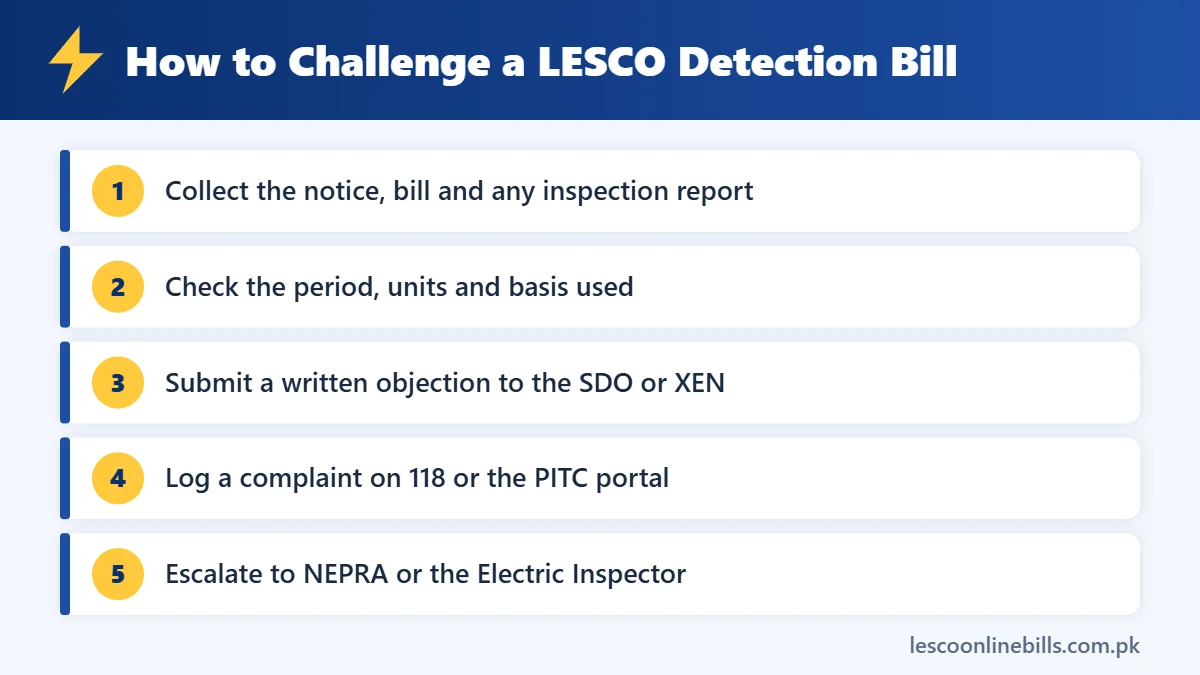
If you believe the bill is wrong, follow these steps in order. Act quickly and keep copies of everything.
- Collect documents: the notice, the detection bill, any inspection report and your last 12 bills.
- Check the details: period charged, units, basis of calculation and whether notice was given.
- Submit a written objection: address it to the SDO, or the XEN at the division office, and get it stamped as received.
- Log a complaint: call 118, send an SMS to 8118 or use the PITC complaint system, and note the complaint number.
- Escalate to NEPRA: if the company does not resolve it, file on the NEPRA online complaint system.
- Meter testing: for disputes about meter accuracy or tampering, you can approach the Electric Inspector or Provincial Office of Inspection, with appeals possible to NEPRA’s Appellate Board.
Our LESCO complaint guide lists all official complaint channels and contact details.
Evidence That Strengthens Your Case
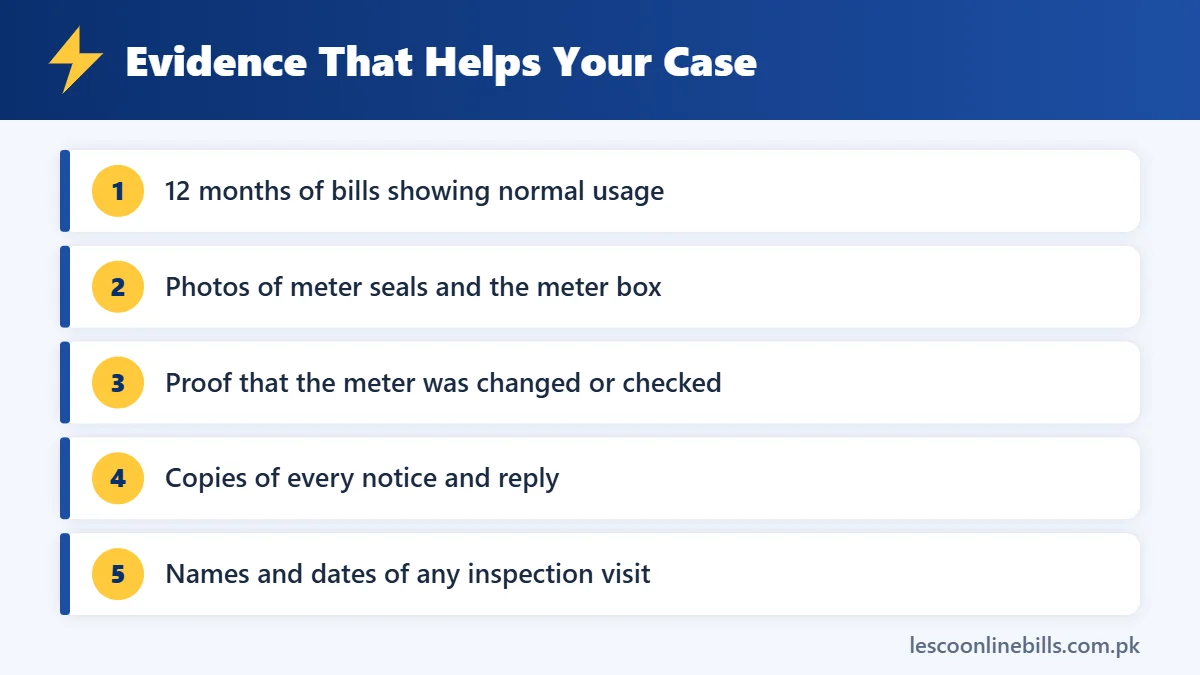
Strong evidence turns a weak objection into a strong one. Gather as much of the following as you can:
- Bills for the past 12 months showing steady, normal usage.
- Photos of the meter, seals and meter box before and after the inspection.
- Records of any earlier meter change or meter check by LESCO.
- Proof that the house was empty or lightly used during the period, if true.
- Copies of every notice, reply and complaint number.
If the meter was replaced, our LESCO meter change guide explains what records to keep. If you recently received a smart meter, see our LESCO smart meter guide, since AMI meters send tamper alerts automatically.
Sample Objection Letter for a LESCO Detection Bill
A short written objection is your most important record. Adapt this sample to your case, sign it and ask the office to stamp a copy as received.
The XEN / SDO,
LESCO [Division / Sub-Division], Lahore.
Subject: Objection to detection bill, Reference No. [14 digits]
Sir,
I have received a detection bill of [units] units for the period [from] to [to]. I object to this bill for the following reasons: (1) no prior notice was served on me before the bill was raised; (2) the bill covers [number] months, which exceeds the limit for my category under the NEPRA Consumer Service Manual; (3) my consumption history for the past 12 months is normal, as shown in the attached bills, but the bill is based on connected load.
I request that the bill be withdrawn or revised as per NEPRA rules, and that the inspection report and calculation sheet be provided to me. Copies of my bills, CNIC and complaint number [number] are attached.
Name, CNIC, mobile number, signature, date
Only include the points that are true in your case. A focused objection backed by documents carries more weight than a long letter of general complaints.
Common Detection Bill Situations
Meter burnt or defective, then a detection bill
A burnt or faulty meter is not theft. If your meter failed because of age, weather or a supply fault, the manual treats it as a defective meter, with average billing limited to two months. A LESCO detection bill should not be used in place of the defective meter rules.
You bought a house with a tampered meter
If tampering happened before you owned the property, explain this in your objection and attach your registry with its date. Also photograph the meter and seals on the day you take possession, so you have a record for the future.
Seals broken but no theft
Seals can break from rust, heat or rough handling during repairs. If you reported the broken seal yourself, your complaint number is strong evidence of good faith. Consumption history matters most here: steady units month after month point away from theft.
Tenant left behind a problem
Owners sometimes discover tampering only after a tenant leaves. Keep the rent agreement and dates, and mention them in your objection. The office may still hold the connection responsible, but clear dates help in settling the amount fairly.
Real Example: A Bill Reduced From Six Months to Three
A domestic consumer in Lahore received a LESCO detection bill covering six months after an inspection found a direct hook. The bill was based on connected load. The consumer filed a complaint with NEPRA, arguing that domestic consumers could be charged for a maximum of three billing cycles without special approval. In June 2026, NEPRA reduced the period to three months.
The case shows two things. First, even where theft is found, the period and method must follow the rules. Second, a calm, documented complaint can significantly reduce an unfair LESCO detection bill.
Paying a LESCO Detection Bill
If the bill is correct, or you reach a settlement, you will need to pay it to avoid disconnection. Large amounts can sometimes be paid in installments, depending on the amount and the officer’s approval level. Ask for this in writing at the revenue office. Our LESCO bill installment guide explains the general installment rules.
If you are disputing the bill, keep your objection and complaint number on record. Ask the office in writing whether your regular monthly bill can be paid separately while the LESCO detection bill is under review, so that your normal account stays clear.
LESCO’s Anti-Theft Drive in Numbers
Detection bills are part of a wider campaign against electricity theft. In 2025, LESCO reported 78,358 theft cases, 62,675 FIRs, 4,318 arrests and more than 84 million units detected, with about Rs1.79 billion recovered. In July 2026 alone, LESCO reported 1,545 cases and 2.74 million units detected.
Theft raises losses that are eventually reflected in everyone’s tariff, which is why the rules allow genuine theft to be charged. At the same time, the limits on months, the notice requirement and the October 2026 ban on manual bills exist to stop honest consumers from being overcharged.
How to Avoid a Detection Bill Dispute
- Never let anyone, including private electricians, open or adjust your meter or seals.
- Report a broken seal or damaged meter box to LESCO yourself and keep the complaint number.
- Keep the meter area clear and accessible for inspection.
- Check your monthly readings using our LESCO meter reading guide so unusual patterns are caught early.
- If you buy a house, check the meter and seals before taking possession and photograph them.
LESCO Detection Bill FAQs
What is a detection bill in LESCO?
A detection bill is a separate charge for units that LESCO says were used but not recorded, usually because of theft, tampering or illegal connection. It must show the reason, units, period, amount and taxes.
How many months can LESCO charge in a detection bill?
Under the NEPRA Consumer Service Manual, domestic and general service consumers can normally be charged for up to three billing cycles, extendable to six months only with CEO approval. Other categories can be charged for up to six cycles. Changes proposed in 2026 were still pending at the time of writing.
Has the government banned manual detection bills?
Yes. In October 2026 the Power Division directed that detection bills may only be issued through the PITC system, and that manual detection billing would be treated as serious misconduct.
How do I challenge a wrong LESCO detection bill?
Submit a written objection to the SDO or XEN with your evidence, log a complaint on 118 or the PITC portal, and if it is not resolved, file a complaint with NEPRA or approach the Electric Inspector.
Is a detection bill valid without prior notice?
NEPRA rules require prior notice before a detection bill is raised. NEPRA has cancelled LESCO detection bills where proper notice was not given.
Can I pay a LESCO detection bill in installments?
Installments may be allowed depending on the amount and approval level. Ask the revenue office in writing and keep your objection on record if you dispute the bill.
Final Words
A LESCO detection bill must follow strict rules: a separate bill, prior notice, limited months and, since October 2026, issue through the PITC system only. Check the period, units and basis, object in writing if anything looks wrong and escalate to NEPRA when needed. With the right evidence and a clear understanding of the limits, you can challenge an unfair bill with confidence. You can always check your regular bill on our LESCO bill check online tool.