LESCO FPA Charges 2026: Fuel Price Adjustment Explained With Monthly Rates
If you read your bill carefully, you will see a line called FPA, and sometimes it adds hundreds or even thousands of rupees. Many consumers think LESCO FPA charges are a hidden fee or a billing mistake. In fact, FPA is a regular monthly adjustment approved by NEPRA, and it can go up or down depending on the cost of fuel used to make electricity.
This guide explains LESCO FPA charges in plain words: what fuel price adjustment means, how NEPRA decides it, why it appears two months later, the monthly rates for 2026, who is exempt, how taxes apply to it, and how it differs from QTA. By the end, you will be able to read the FPA line on your bill with confidence.
Table of Contents
What Are LESCO FPA Charges?
FPA stands for fuel price adjustment. NEPRA documents often call it FCA, or fuel charges adjustment. When NEPRA sets electricity tariffs, it assumes a certain fuel cost per unit, called the reference fuel cost. Every month, the actual cost of fuel used by power plants is different, because fuel prices, the mix of power plants and imports change.
The difference between the actual cost and the reference cost is the fuel adjustment. If actual fuel costs are higher, consumers pay an extra amount per unit. If they are lower, consumers get a credit. These LESCO FPA charges therefore move up and down from month to month.
The legal basis
Monthly fuel adjustments are allowed under the NEPRA Act. They apply uniformly to consumers of the government distribution companies, including LESCO, and under federal policy the same uniform adjustment also applies to K-Electric consumers.
How NEPRA Decides the Monthly FPA
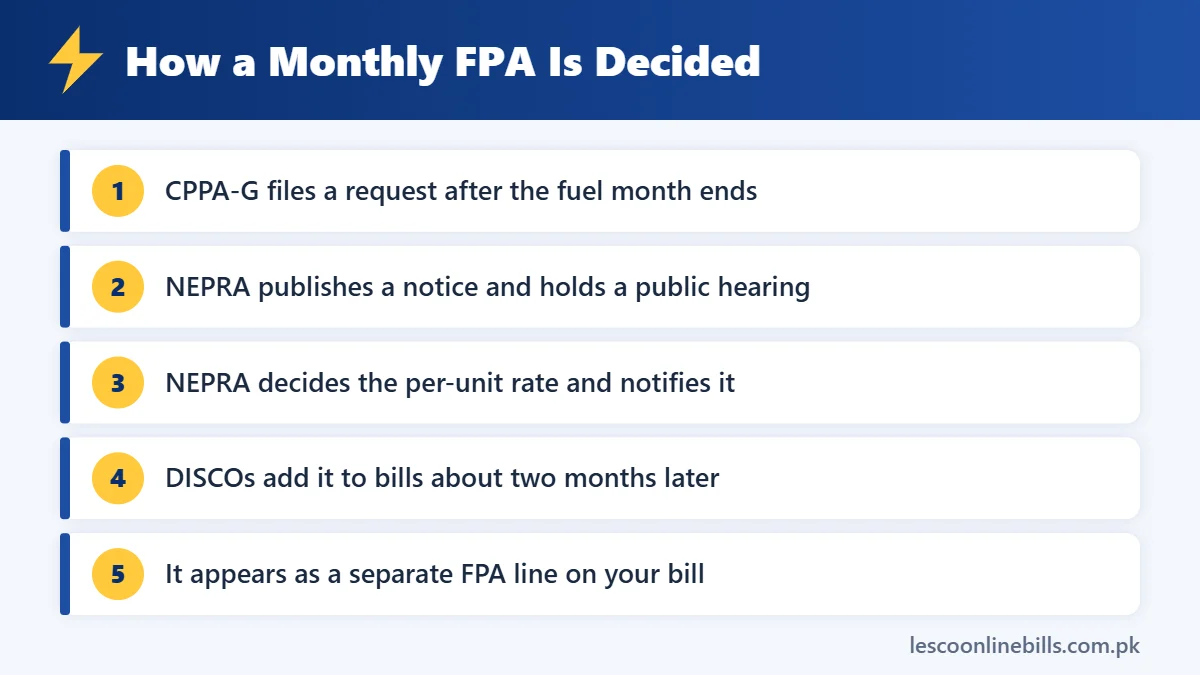
Every month follows a set process. Using July 2026 as an example:
- Request: CPPA-G (the Central Power Purchasing Agency) filed the July request on 13 August 2026.
- Notice: NEPRA published a hearing notice on 18 August.
- Hearing: NEPRA held a public hearing on 27 August, in person and online.
- Decision: NEPRA issued its decision and notification on 4 September.
- Billing: the July adjustment appeared in September bills.
This is why LESCO FPA charges always relate to an earlier month. If bills have already been printed before the notification, the adjustment moves to the next billing month. NEPRA requires it to be shown separately on the bill.
LESCO FPA Charges in 2026: Monthly Rates
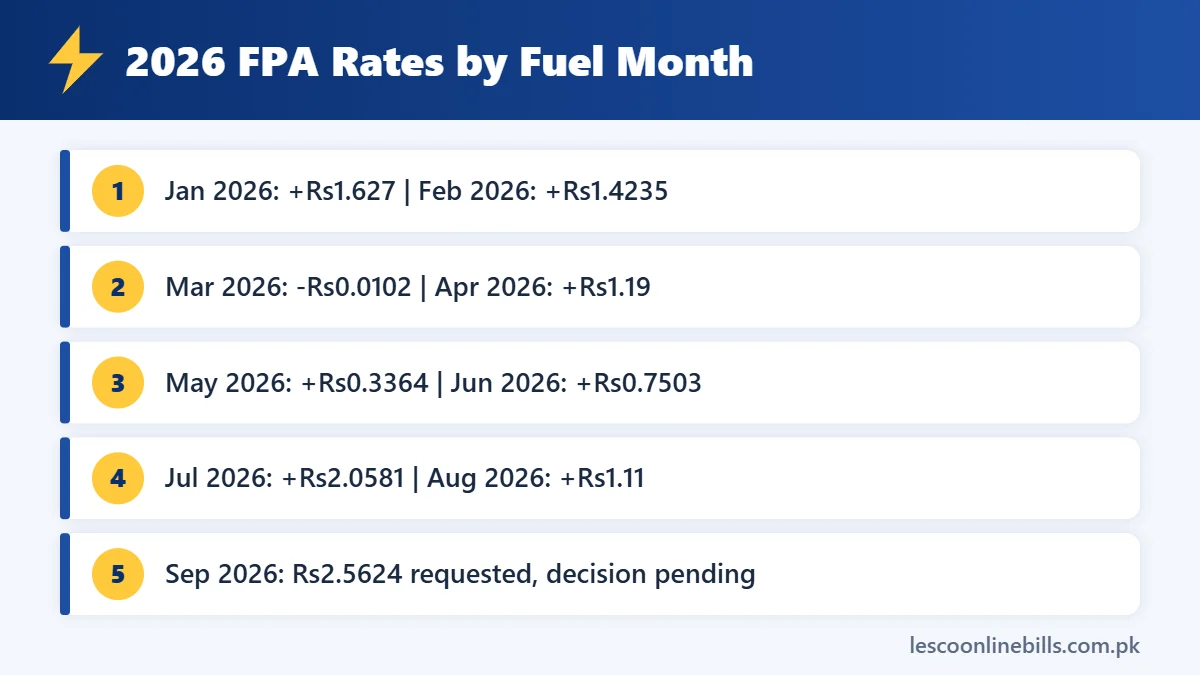
Here are the monthly fuel adjustment rates decided by NEPRA for the government distribution companies, including LESCO, as reported in official decisions and the news. A plus sign means an increase and a minus sign means a credit.
| Fuel month | FPA per unit | Billing month (approx.) |
|---|---|---|
| December 2025 | +Rs0.284 | February 2026 |
| January 2026 | +Rs1.627 | March 2026 |
| February 2026 | +Rs1.4235 | April 2026 |
| March 2026 | -Rs0.0102 | May 2026 |
| April 2026 | +Rs1.19 | June 2026 |
| May 2026 | +Rs0.3364 | July 2026 |
| June 2026 | +Rs0.7503 | August 2026 |
| July 2026 | +Rs2.0581 | September 2026 |
| August 2026 | +Rs1.11 | October 2026 |
| September 2026 | Rs2.5624 requested; decision pending | November 2026, if approved |
For September 2026, CPPA-G asked for about Rs2.56 per unit, saying the actual fuel cost was about Rs10.02 per unit against a reference of about Rs7.46. NEPRA held the hearing on 29 October 2026 and reserved its decision. Check NEPRA’s notifications for the final figure before assuming the amount on your November bill.
How LESCO FPA Charges Appear on Your Bill
On a LESCO bill, the fuel adjustment usually appears in the charges section as a separate FPA line. Some bills also show related tax lines, such as GST on FPA, in the government charges section. A sample LESCO bill reported in the media showed GST on FPA charged at the standard sales tax rate.
The FPA line is calculated as a per-unit rate multiplied by the relevant units. In practice, it is generally applied to the units linked to the reference fuel month, which is why the FPA amount may not match your current month’s units exactly. Our LESCO bill explained guide shows where each charge sits on the bill.
A simple example
Suppose the relevant month’s units on your account were 300 and the approved FPA was Rs1.11 per unit. The FPA would be about 300 x Rs1.11 = Rs333, before any taxes on it. This is only an illustration; your bill shows the exact figures.
Who Is Exempt From LESCO FPA Charges?
NEPRA decisions in 2026 exempted certain groups from monthly fuel adjustments:
- Lifeline consumers: the smallest domestic users.
- EV charging stations.
- Prepaid consumers who opted for the prepaid tariff.
The March 2026 review decision also referred to protected consumers, but later decisions did not clearly repeat this, so check your own bill. The adjustment does apply to units billed under the incremental consumption package. Our LESCO bill subsidy guide explains lifeline and protected status.
FPA vs QTA: What Is the Difference?
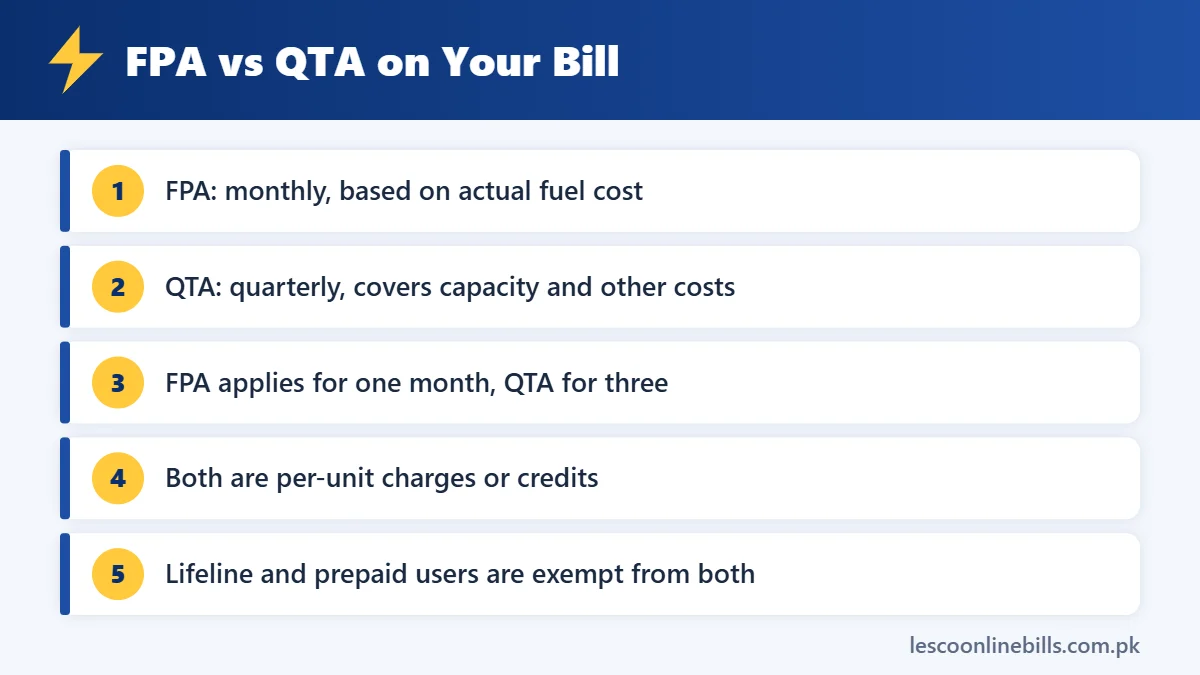
Your bill may also show QTA, the quarterly tariff adjustment. It is easy to confuse the two, but they cover different costs:
| Point | FPA | QTA |
|---|---|---|
| Frequency | Monthly | Quarterly |
| What it covers | Fuel cost variation | Capacity charges, power purchase price, O&M, system charges and loss variations |
| Duration on bill | One month | Spread over three months |
| Set by | NEPRA | NEPRA, with government notification |
QTA rates applied in 2026 included about +Rs0.33 per unit from December 2025 to February 2026, +Rs0.35 from March to May 2026, a reduction of about Rs1.99 from June to August 2026, and +Rs0.52 from September to November 2026.
Where Your FPA Money Goes
The fuel adjustment you pay does not stay with LESCO as profit. It passes through the power purchase chain to cover the real cost of fuel used by power plants. LESCO collects it on behalf of the system, and the amount is settled through the Central Power Purchasing Agency. This is also why NEPRA, not LESCO, decides the rate after a public hearing in which consumers and businesses can raise objections.
Anyone can follow these hearings or read the decisions online. If you want to understand who sets each charge on your bill, our LESCO full form guide explains the roles of LESCO, NEPRA, PITC and the Power Division.
Why LESCO FPA Charges Change Every Month
- Fuel prices: changes in the price of gas, LNG, coal and oil.
- Generation mix: more hydropower in summer usually lowers fuel costs, while winter relies more on thermal plants.
- Exchange rate: imported fuel costs rise when the rupee weakens.
- Demand: high demand can bring costlier plants online.
Because of these factors, LESCO FPA charges are hard to predict months ahead. Following NEPRA’s monthly decisions is the only reliable way to know the next adjustment.
How to Reduce the Impact of FPA on Your Bill
You cannot avoid FPA if your connection is not exempt, but you can reduce its effect:
- Lower your monthly units, since FPA is charged per unit.
- Shift heavy appliance use outside peak hours. See our LESCO peak hours guide.
- Consider solar for daytime use, keeping in mind the 2026 net billing rules in our LESCO net metering guide.
- Estimate your next bill with our LESCO bill calculator and plan your budget.
Where to Check the Latest FPA Rate
NEPRA publishes every fuel adjustment decision and notification on its website. To confirm the rate before you pay, check these official sources:
- The NEPRA monthly FPA decision for July 2026, as an example of how decisions are published.
- The tariff and notifications sections of the NEPRA website for newer months.
- Hearing notices on NEPRA’s website, which show the rate requested before a decision.
Newspapers also report the decisions, usually on the day NEPRA issues them. Compare the notified rate with the FPA line on your bill to make sure LESCO FPA charges have been applied correctly.
LESCO FPA Charges for Solar Users
If you have rooftop solar, the fuel adjustment generally applies to the units you import from the grid. Exported units are handled under your net metering or net billing terms. This means solar users who import fewer units usually pay less FPA. Check the import units and the FPA line together on your bill to see how the adjustment was calculated.
LESCO FPA Charges for Shops and Industries
Commercial and industrial consumers often use far more units than homes, so LESCO FPA charges can make a big difference to their monthly costs. A small increase of Rs1 per unit on 5,000 units adds about Rs5,000 before tax. Businesses should track NEPRA’s monthly decisions, plan production around off-peak hours where possible and budget for months when fuel costs are usually higher.
Does FPA Affect Protected Status or Slabs?
FPA is a per-unit adjustment added to the bill; it does not change the number of units you consumed. Your slab and protected status depend on your units, not on the FPA amount. However, because FPA raises the total bill, higher-usage months feel even heavier. Staying within your slab limits keeps both the base charge and the adjustment lower.
Myths About LESCO FPA Charges
| Myth | Fact |
|---|---|
| FPA is a LESCO penalty. | FPA is a regulated adjustment decided by NEPRA for all government DISCOs. |
| FPA is always an increase. | It can be a credit when actual fuel costs are below the reference cost, as in March 2026. |
| FPA is charged on this month’s units. | It relates to an earlier fuel month, usually about two months before the bill. |
| Everyone pays FPA. | Lifeline, EV charging and prepaid consumers have been exempt in 2026 decisions. |
| The sub-division can waive FPA. | It cannot waive the rate, but it can correct errors in how it was applied. |
How to Read the FPA Line Step by Step
- Find the FPA line in the charges section of your bill.
- Note the fuel month it relates to, if shown.
- Check NEPRA’s notified rate for that month.
- Multiply the rate by the relevant units to estimate the amount.
- Look for any tax lines on FPA in the government charges section.
If your estimate is close to the bill, the LESCO FPA charges are most likely correct. If there is a big difference, ask your sub-division for a breakdown.
When FPA Looks Wrong
FPA itself is set by NEPRA, so your sub-division cannot remove it. But it can correct errors, such as FPA charged to an exempt consumer, FPA applied to wrong units or FPA charged twice for the same month. If you suspect any of these, compare the FPA line with NEPRA’s notified rate and the relevant units, then apply for correction. Our LESCO bill correction guide explains how.
FPA Trends: What 2026 Tells Us
Looking at the 2026 monthly decisions, a few patterns stand out. Winter and early spring months, when thermal power plants run more, produced higher adjustments, such as about Rs1.63 for January and Rs1.42 for February. March brought a tiny credit. Summer months had mixed results, with July 2026 rising to about Rs2.06 per unit as fuel costs climbed.
The September 2026 request of about Rs2.56 per unit shows that late-summer and autumn months can also be costly. These swings are why it is wise to keep some room in your monthly budget for LESCO FPA charges, especially if your household uses more than 300 units a month.
Planning Your Budget Around FPA
- Keep a small buffer, for example a few hundred rupees, in your monthly electricity budget.
- Check NEPRA hearing news each month to see what rate has been requested.
- Use the requested rate and your units to estimate the coming FPA amount.
- Pay on time to avoid late payment surcharge on top of the adjustment.
Our LESCO unit rate page and LESCO bill taxes guide help you see the full picture of what makes up your bill.
LESCO FPA Charges FAQs
What is FPA in a LESCO bill?
FPA (fuel price adjustment) is a per-unit charge or credit that reflects the difference between the actual cost of fuel used to generate electricity in a month and the reference fuel cost assumed in the tariff. NEPRA decides it every month.
Why is FPA charged two months later?
NEPRA needs the actual fuel cost data for a month, then holds a hearing and issues a decision. Because of this process, the FPA for a fuel month usually appears in bills about two months later.
How is FPA calculated on my bill?
NEPRA sets a per-unit FPA rate. On your bill, it is generally applied to the units linked to the relevant fuel month, and taxes may be added on it as separate lines.
Do lifeline consumers pay FPA?
No. NEPRA decisions in 2026 exempted lifeline consumers, EV charging stations and prepaid consumers who chose the prepaid tariff from the monthly fuel adjustment.
What is the FPA in November 2026 bills?
For September 2026, CPPA-G asked for an increase of about Rs2.56 per unit. NEPRA held the hearing on 29 October 2026 and reserved its decision. If approved, it would appear in November bills. Check NEPRA’s notification for the final figure.
What is the difference between FPA and QTA?
FPA is a monthly adjustment for fuel costs. QTA is a quarterly adjustment for other power purchase costs, such as capacity payments and system charges, and is spread over three months of bills.
Final Words
LESCO FPA charges are a normal part of electricity billing, not a hidden fee. NEPRA sets the rate every month based on actual fuel costs, and it reaches your bill about two months later as a separate line. In 2026 the rate moved from a tiny credit to more than Rs2 per unit, with lifeline and prepaid consumers exempt. Check the FPA line against NEPRA’s notified rate, keep an eye on your units and use our LESCO bill check online tool to see your latest bill.