Green Meter Price in Pakistan 2026: LESCO Solar Meter Cost and Latest Rules
If you are planning rooftop solar in Lahore or nearby districts, one cost always comes up: the meter. People search for the green meter price because without the right meter, your solar system cannot be connected to the LESCO grid or credited for the units it exports. The problem is that prices, meter types and rules have changed several times since 2024.
This guide explains the green meter price in Pakistan for LESCO consumers in 2026. You will see the reported price history, why LESCO moved from green meters to AMI smart meters, what your demand notice includes, whether you can buy a meter yourself, how long installation takes and how the new net billing rules affect the value of your solar system. Where reports differ, we say so clearly.
Table of Contents
What Is a Green Meter?
A green meter is a bi-directional (two-way) electricity meter. A normal meter only counts the units you take from the grid. A green meter counts two things: the units you import from LESCO and the units your solar panels export to the grid. Both numbers appear on your bill, and the difference decides how much you pay or how much credit you get.
The name comes from the green colour of many early models used for net metering. Over time, people started calling any solar net metering meter a “green meter”, even when the device itself was a different colour or a newer smart model. When people ask about the green meter price today, they usually mean the total cost of the meter needed for a solar connection.
Why the meter matters so much
- Without it, LESCO will not approve your solar connection for net billing.
- It records export units, which decide your credit on the bill.
- It records peak and off-peak imports on time-of-use connections.
- Errors in the meter or its registration can delay your case for weeks.
Green Meter vs AMI Smart Meter
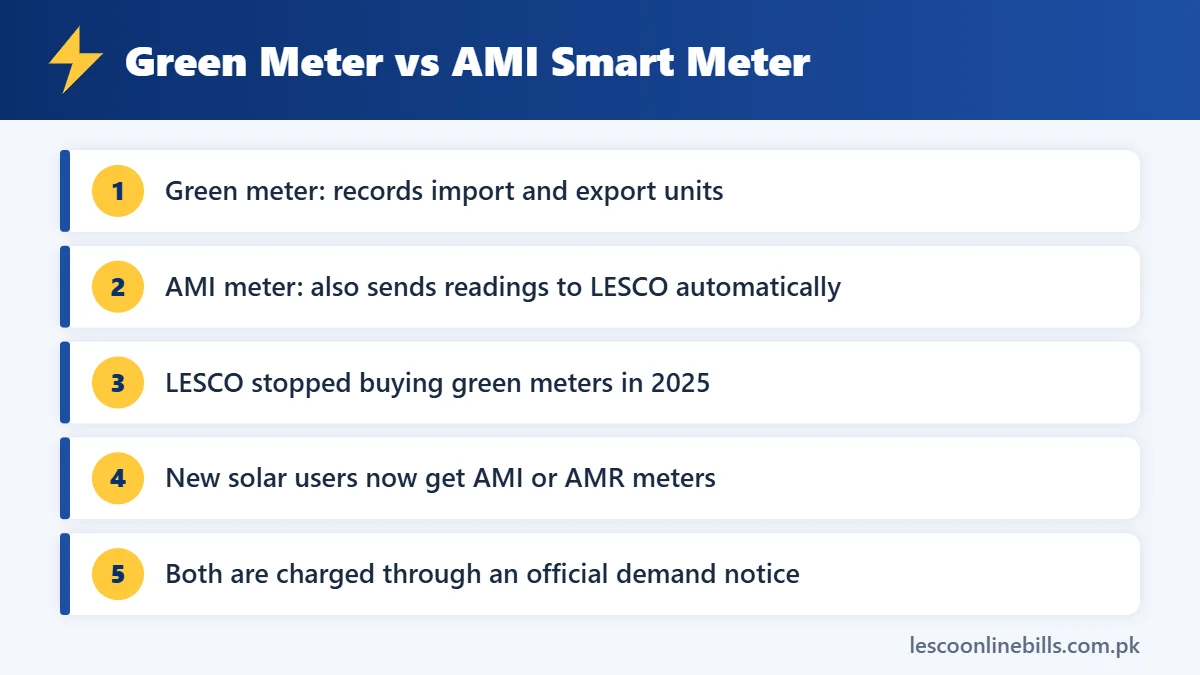
In 2025 LESCO changed its policy for solar users. It stopped buying the older green bidirectional meters and started a phased switch to AMI (Advanced Metering Infrastructure) and AMR (Automatic Meter Reading) smart meters. These smart meters record import and export like a green meter, but they also send readings directly to LESCO’s control room.
| Feature | Green meter | AMI / AMR smart meter |
|---|---|---|
| Import and export recording | Yes | Yes |
| Automatic reading to LESCO | No, read manually | Yes |
| Remote functions | No | Possible on AMI models |
| LESCO’s 2026 policy | No longer purchased | Preferred for solar users |
| Cost | Lower in earlier years | Higher in most reports |
The Power Division also directed distribution companies to replace existing green meters with AMI meters for solar users. Some companies, such as IESCO, faced complaints after asking users to pay for replacements, and that plan was put on hold in late 2025. Our LESCO smart meter guide explains how AMI meters work.
Green Meter Price History for LESCO
Here is how the reported green meter price and solar meter cost for LESCO users changed over the last two years. These figures come from news reports and LESCO announcements as reported in the media.
| Period | Reported cost | Notes |
|---|---|---|
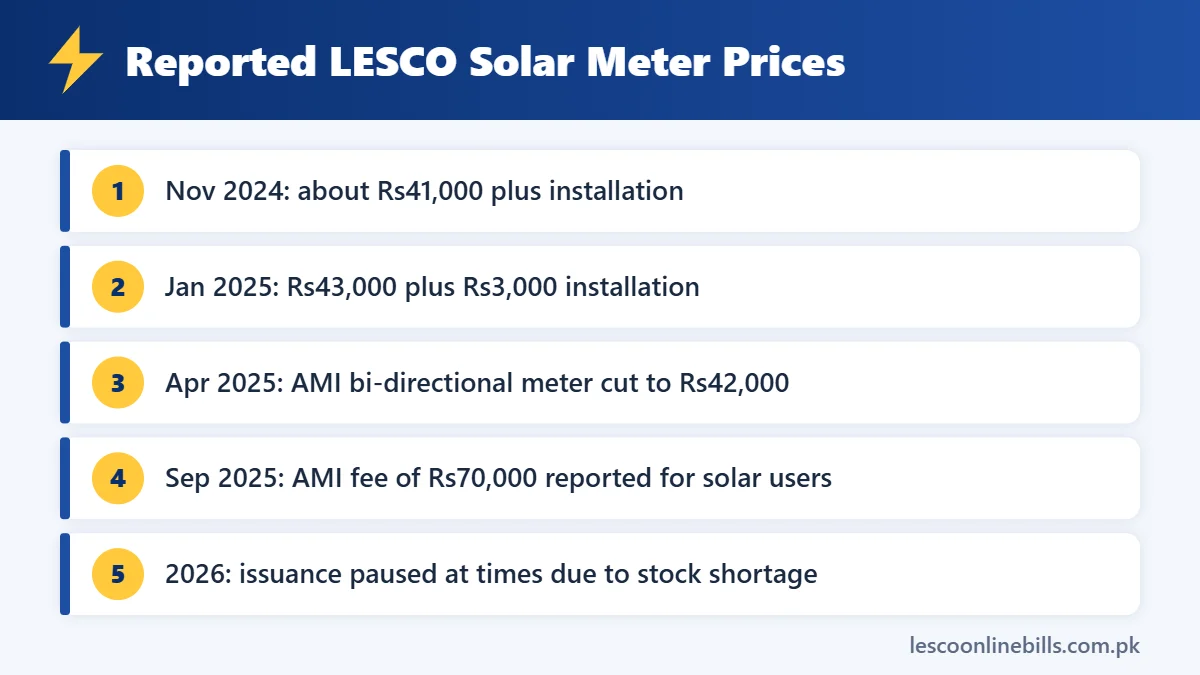
| November 2024 | About Rs41,000 plus installation | Green bidirectional meter |
| January 2025 | Rs43,000 plus Rs3,000 installation | Paid through demand notice |
| April 2025 | AMI bi-directional meter cut from Rs52,000 to Rs42,000 | Store charges included |
| September 2025 | About Rs70,000 AMI fee for solar users | Single report; earlier figure quoted as Rs35,000 |
| September 2026 | New issuance paused for a time | Stock shortage and backlog reported |
The September 2025 figure is the one most people quote, but it comes from a single news source and does not split single-phase and three-phase meters. Treat it as an indication, not a fixed rate. The only reliable green meter price for your case is the amount printed on your own demand notice.
Why the Green Meter Price Keeps Changing
- Change of meter type: moving from green meters to AMI and AMR smart meters raised the base cost.
- Imported components: meter prices are affected by the exchange rate and import costs.
- Stock shortages: when LESCO runs short, procurement in a hurry can change prices and delay installations.
- Policy changes: the shift to net billing in 2026 and new rules on meter purchase affected who pays and how.
- Single vs three phase: three-phase meters are usually more expensive, and many larger solar systems need them.
What the Green Meter Price Includes in the Demand Notice
When LESCO approves your solar case, it issues a demand notice. This is the official bill for your connection costs. It usually includes:
- The cost of the meter (green, AMI or AMR, as applicable).
- Installation charges.
- Store or associated charges.
- Any security or other charges listed by LESCO.
Installers sometimes add their own file or service charges on top of LESCO’s demand notice. These are private charges, not LESCO fees. Ask your installer for a written breakdown so you know exactly how much of the total is the green meter price and how much is the installer’s service.
Can You Buy a Green Meter From the Market?
This is one of the most confusing points. The revised NEPRA Consumer Service Manual (2025) says that if a distribution company does not have meters in stock, the consumer may be asked to buy one from the company’s approved vendors. In October 2025, LESCO allowed purchases of some meters from approved makers under an NOC. Later, in March 2026, it banned open-market purchase of single-phase AMI meters.
In short, do not buy any meter on your own. Ask your sub-division in writing whether you must buy from an approved vendor and get the vendor list and NOC from LESCO. A meter bought from the wrong source can be rejected, and you will lose both money and time.
How to Get a Solar Meter From LESCO
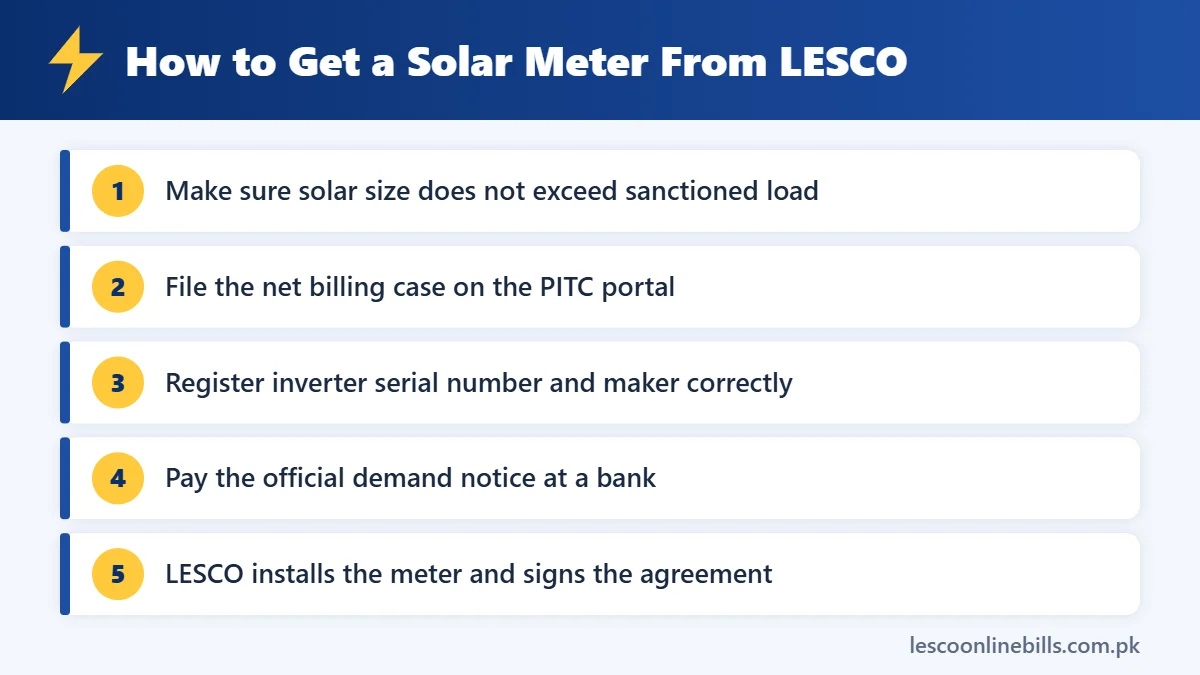
- Check your sanctioned load: under the 2026 rules your solar size cannot be larger than your sanctioned load. If needed, apply for a LESCO load extension first.
- Choose a certified installer: work with an AEDB-certified installer who understands the latest LESCO rules.
- File the case online: the net billing application is submitted on the PITC net billing portal.
- Register inverter details: since November 2025, the inverter serial number and maker must match LESCO’s ERP records, or the meter allocation can be cancelled.
- Pay the demand notice: this covers the meter and related charges.
- Meter installation and agreement: LESCO installs the meter and signs the agreement, and your solar connection goes live.
How the 2026 Net Billing Rules Affect Your Costs
The NEPRA Prosumer Regulations 2026, notified on 9 February 2026, replaced net metering with net billing for new applicants. Under net billing, exported units are bought at the national average energy purchase price, reported at around Rs10 to Rs11 per unit for new users, while imported units are charged at your normal tariff. Agreements now run for five years instead of seven.
For existing users, LESCO’s export rate was reported to fall from Rs25.98 to Rs25.32 per unit from January 2026 bills. These changes matter because they affect how quickly your solar investment, including the green meter price, pays for itself. Our LESCO net metering guide explains the full set of rules.
A simple payback check
Before you pay for a meter, estimate how many units you will use directly during the day and how many you will export. Daytime use saves you the full tariff, while exported units earn the lower net billing rate. A system sized close to your daytime load usually recovers its costs, including the meter, faster than an oversized system that exports most of its output.
Green Meter Price vs Total Solar Cost
It helps to see the green meter price in context. For most homes, the meter is only one part of the total solar budget. Panels, inverter, structure, wiring, protection devices and installation usually cost far more. Still, the meter is a cost you cannot avoid, and delays in getting it can hold up your whole system.
| Cost item | Who sets the price | What to check |
|---|---|---|
| Solar panels and inverter | Market and installer | Brand, warranty and efficiency |
| Structure, wiring and protection | Installer | Quality and safety standards |
| Green or AMI meter | LESCO, through the demand notice | Official green meter price on the notice |
| Installation and store charges | LESCO | Listed on the demand notice |
| Installer file or service fee | Installer | Written breakdown before you pay |
When you compare quotations, ask each installer to show the green meter price separately from their own charges. Some quotations bundle everything together, which makes it hard to see whether you are paying the official meter cost or an inflated figure.
Single-Phase vs Three-Phase: Does the Green Meter Price Differ?
Yes, in most cases. Three-phase meters are larger and more complex, so the green meter price for a three-phase connection is usually higher than for single-phase. Many solar systems of 5 kW and above sit on three-phase connections, and time-of-use billing also applies at that size.
Reliable 2026 figures separating single-phase and three-phase solar meter costs for LESCO were not available at the time of writing. If your installer quotes a green meter price, ask whether it is for single-phase or three-phase and compare it with the amount on your LESCO demand notice.
Questions to Ask Your Installer About the Green Meter Price
- Is the green meter price in your quotation the official LESCO amount or an estimate?
- Will LESCO supply the meter, or must I buy it from an approved vendor?
- Is the meter single-phase or three-phase, and is it AMI, AMR or a green bidirectional model?
- Who will register my inverter serial number with LESCO, and when?
- What happens to my payment if LESCO runs out of meters?
- Are your file and service charges separate from the green meter price?
Clear answers to these questions protect you from surprises. A trustworthy installer will happily show the official green meter price and explain each extra charge in writing.
Example: Planning a 5 kW Home System
Suppose a family in Lahore with a 5 kW sanctioned load plans a 5 kW solar system. Their installer files the net billing case, registers the inverter details and waits for LESCO’s demand notice. The notice lists the meter, installation and store charges. The family pays it at their bank, keeps the receipt and checks the portal weekly.
Because the system matches their sanctioned load and the inverter details are correct, the case moves without objections. The only delay comes from meter stock, which they track through the sub-division. Once installed, they photograph both registers and check their first bill. This simple planning keeps the green meter price predictable and avoids extra costs later.
Meter Shortages and Delays in 2026
LESCO has faced meter shortages several times. In September 2026, reports said new bi-directional meter issuance had been suspended for a period because of low stock, even though many consumers had already paid demand notices. This created a backlog of solar users waiting for meters.
If you are caught in a delay, keep a record of your application ID, demand notice payment date and every follow-up. Contact your sub-division first, then file a complaint through 118 or the PITC complaint system. Our LESCO complaint guide lists every channel, and our LESCO office guide shows how to find your sub-division.
Checking Your Solar Meter After Installation
- Photograph the import and export registers on the day of installation.
- Check that the meter number on your first solar bill matches the meter.
- Confirm that export units appear on the bill.
- Compare the readings each month using our LESCO meter reading guide.
- Read the bill sections carefully with our LESCO bill explained guide.
Green Meter Price FAQs
What is the green meter price in Pakistan in 2026?
For LESCO, reported solar meter costs have ranged from about Rs41,000 to Rs43,000 for green meters in late 2024 and early 2025, about Rs42,000 for an AMI bi-directional meter in April 2025, and a reported Rs70,000 AMI fee in September 2025. The exact amount for your case is printed on your demand notice.
Is LESCO still issuing green meters?
LESCO stopped buying traditional green bidirectional meters in 2025 and moved solar users to AMI or AMR smart meters. In September 2026 it was also reported that new issuance was paused for a while because of a stock shortage.
Can I buy a green meter from the market?
Under the revised NEPRA Consumer Service Manual, a consumer may be asked to buy a meter from the company’s approved vendors only when the company has no stock. LESCO has also restricted open-market purchases of some meters, so always follow the written instructions from your sub-division.
What is the difference between a green meter and an AMI meter?
Both record electricity imported from and exported to the grid. An AMI meter also communicates readings to LESCO automatically and can support remote functions, which is why LESCO now prefers it for solar users.
Is net metering still available in 2026?
New solar applicants now come under net billing, introduced by the NEPRA Prosumer Regulations notified on 9 February 2026. Exported units are bought at a lower rate than before, while users approved earlier keep their old terms until their agreements end.
How long does LESCO take to install a solar meter?
The 2026 regulations set short deadlines for review and interconnection, but meter shortages and document problems have caused delays. Keep your demand notice receipt and follow up with your sub-division and the PITC portal.
Final Words
The green meter price in Pakistan is no longer a single fixed number. For LESCO users, the old green meters have given way to AMI and AMR smart meters, and reported costs have ranged widely between 2024 and 2026. Check your sanctioned load, work with a certified installer, follow LESCO’s written instructions on meter purchase and rely only on your official demand notice for the final amount. With the right planning, your solar system can still deliver strong savings under the 2026 net billing rules.