LESCO Load Extension 2026: How to Increase Sanctioned Load Online (Change of Load)
Adding an air conditioner, building a new floor or installing solar often means you need more power than your connection allows. LESCO load extension, also called change of load or extension of load, increases the sanctioned load on your existing connection so you can use more appliances legally and safely. It also prevents penalties for running above your approved limit.
This guide explains when you need a LESCO load extension, how to calculate the load you need, the documents and fees, how to apply online and at the office, who approves it, how long it takes and what changes on your bill and meter afterwards.
Remember that your sanctioned load now affects your monthly bill as well. Read LESCO fixed charges before you ask for more load.
Table of Contents
What Is LESCO Load Extension?
Every connection has a sanctioned load, measured in kilowatts (kW). It is the maximum load LESCO has approved for your premises, and it is printed on your bill. A LESCO load extension raises this limit. The connection, reference number and meter location usually stay the same, although the meter may be upgraded.
The process is set out in clause 2.14 of the NEPRA Consumer Service Manual. It covers how to apply, the documents required, who approves the request and how the demand notice works. The same procedure also applies to connections with solar under net metering or net billing.
Sanctioned load vs connected load
Sanctioned load is the approved limit on paper. Connected load is the total rating of all appliances wired into your premises. If your connected load regularly exceeds your sanctioned load, you are drawing more than approved, which can overload LESCO’s transformer and lead to notices or extra charges.
When Do You Need a LESCO Load Extension?
- New air conditioners: a single 1.5-ton inverter AC can draw 1.5 to 2 kW at full load.
- House extension: a new floor or portion adds lights, fans, geysers and appliances.
- Solar installation: under the 2026 rules, solar capacity cannot exceed sanctioned load.
- Business growth: new machines, freezers or ovens in a shop or workshop.
- Frequent tripping: breakers that trip when several appliances run together.
- A notice on your bill: LESCO may print a notice if it finds your load is higher than sanctioned.
How to Calculate the Load You Need
Before applying for a LESCO load extension, add up the wattage of the appliances you expect to run at the same time. You do not need to count every device at full power all day; focus on realistic peak use, such as a summer evening.
| Appliance | Typical load (approx.) |
|---|---|
| 1.5-ton inverter AC | 1.5 to 2.0 kW |
| 1-ton AC | 1.0 to 1.3 kW |
| Refrigerator | 0.2 to 0.4 kW |
| Electric iron | 1.0 kW |
| Water pump (1 HP) | 0.75 kW |
| Microwave oven | 1.0 to 1.5 kW |
| Fans and LED lights (whole house) | 0.5 to 1.0 kW |
For example, a house running two 1.5-ton ACs, a fridge, a pump, fans and lights together may need around 5 to 6 kW. Ask your electrician to confirm the figure in the wiring test report, since that report is part of the LESCO load extension application.
Documents Required for LESCO Load Extension
Under clause 2.14 of the manual, the application should include:
- Wiring test report: from the Electric Inspector or a licensed wiring contractor, confirming your internal wiring can safely carry the new load.
- Last paid bill: with no arrears, deferred amount or pending installments.
- Attested CNIC copy: of the registered consumer.
- Power supply contract: or a copy of your original agreement.
- Ownership proof: usually requested on the online form.
- Capital cost: if new equipment such as a bigger service cable or transformer work is needed.
The application must be made in the registered consumer’s name. If the bill still shows a previous owner, complete the transfer first. Our LESCO change of name guide explains how.
How to Apply for LESCO Load Extension Online
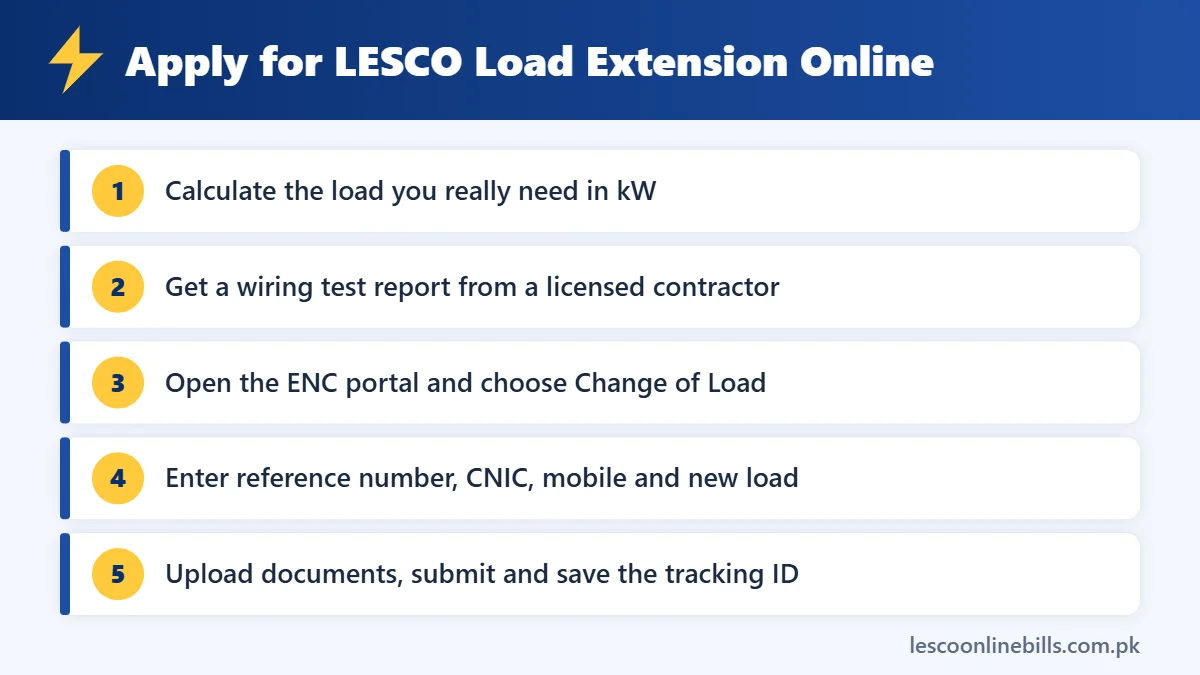
LESCO uses the ENC portal run by PITC for connection services. The online LESCO load extension process generally works as follows:
- Open the portal: visit the ENC portal and choose the change of load or extension of load option.
- Select LESCO: make sure your distribution company is selected correctly.
- Enter details: reference number, CNIC, mobile number, current sanctioned load and the new load you need.
- Upload documents: CNIC, last paid bill, ownership proof and wiring test report, within the file size limits shown on the form.
- Submit: note the tracking ID and keep a screenshot.
- Survey and demand notice: LESCO checks the site and issues a demand notice for the extra security and any capital cost.
- Pay and upgrade: after payment, LESCO updates your sanctioned load and changes the meter if required.
Your reference number is printed at the top of your bill. Our LESCO reference number guide shows where to find it.
Applying at the Sub-Division Office
If you prefer, you can apply for a LESCO load extension in person. Collect the application form free from your sub-division, fill it in, attach the documents and submit it at the customer service or commercial desk. Ask for a receipt with the date. In-person applications are useful when there are other issues to fix at the same time, such as a wrong tariff or meter problem.
LESCO Load Extension Fee and Security Deposit
There is no fixed processing fee in the manual. Instead, you pay the security deposit for the additional load only, plus any capital cost if new equipment is needed. The security is calculated per kW according to your tariff category.
| Category | Security per kW (rates cited in 2025) |
|---|---|
| Domestic A-1, urban | Rs1,220 |
| Domestic A-1, rural | Rs610 |
| Commercial A-2, urban | Rs1,810 |
These figures come from a 2025 NEPRA petition document in which LESCO also asked for much higher rates. We found no final NEPRA decision on that request at the time of writing, so treat the table as a guide. Your demand notice shows the exact amount for your LESCO load extension.
Who Approves Your Request and How Long It Takes
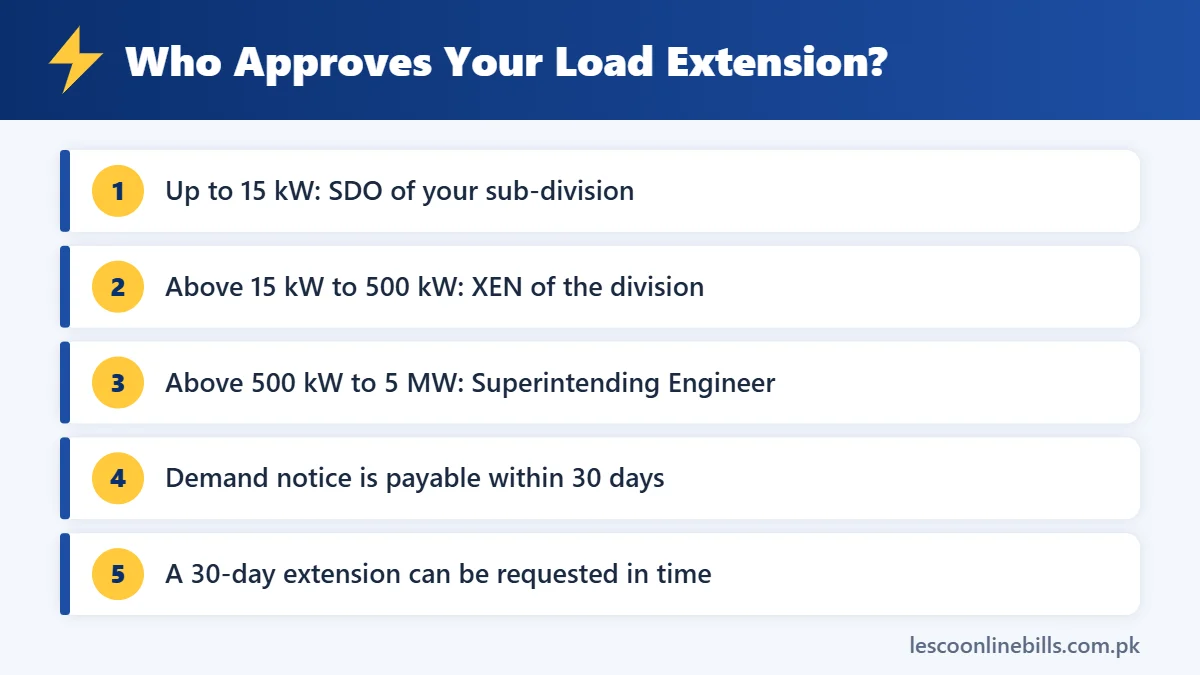
The manual sets approval levels by size of load:
| New load | Approving officer |
|---|---|
| Up to 15 kW | SDO (sub-division) |
| Above 15 kW to 500 kW | XEN (division) |
| Above 500 kW to 5 MW | Superintending Engineer (circle) |
The demand notice must be paid within 30 days of issue. If you need more time, you can request a 30-day extension at least three days before the deadline. Third-party guides cite around 30 days for a household LESCO load extension up to 15 kW and longer for larger loads. Complete documents are the best way to avoid delays.
Three-Phase and Time-of-Use Meters
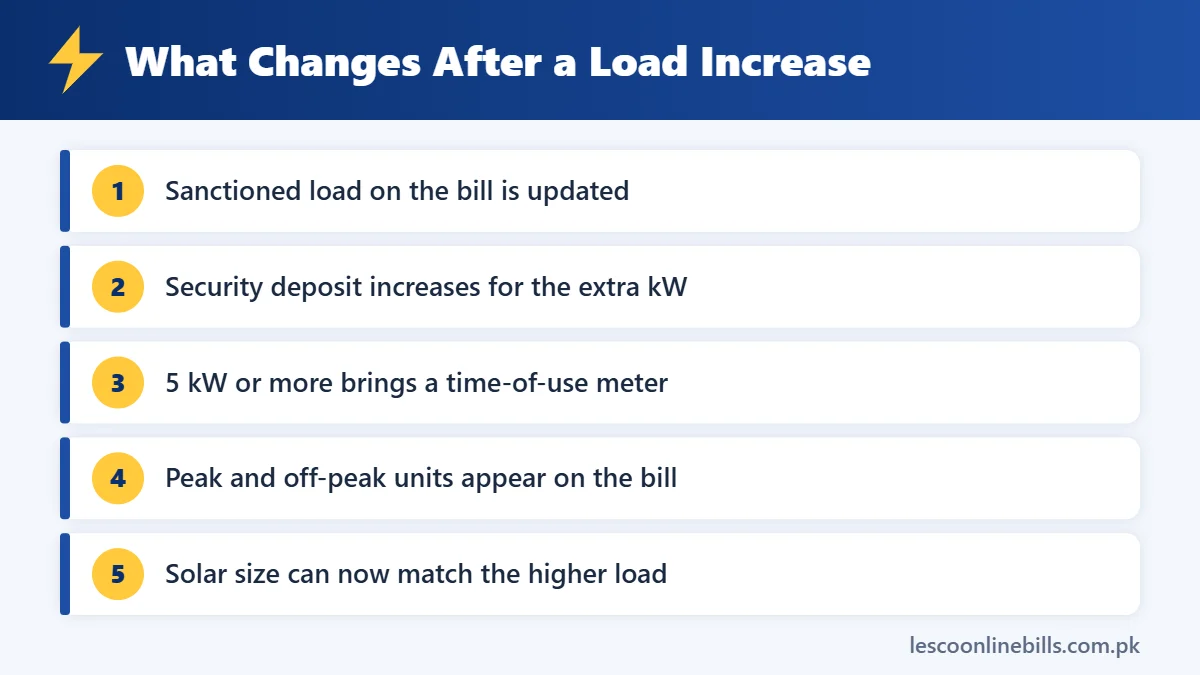
Load size affects your meter and tariff. When a domestic single-phase load approaches 5 kW, the company issues a notice for load extension and installs a time-of-use (TOU) meter. Connections of 5 kW and above are billed on TOU tariff, with separate peak and off-peak rates.
This means a LESCO load extension past 5 kW can change how your bill is calculated. Using heavy appliances outside peak hours becomes more important. Our LESCO peak hours guide lists current timings, and our LESCO meter change guide explains what to check when your meter is replaced.
What If You Use More Load Than Sanctioned?
A 2023 amendment to the manual deals with unauthorised extra load. If LESCO finds your load is higher than sanctioned:
- A notice is printed on your bill asking you to apply for load extension.
- If you do not respond, the load can be extended automatically.
- The additional security is then recovered in three to six installments.
- Back-billing for the extra load is limited to six months.
- Any required change of tariff must be made within 10 days.
Applying for a LESCO load extension yourself is better than waiting for a notice. You choose the right load, plan the cost and avoid surprises on your bill.
Load Extension for Solar Users
Under the NEPRA Prosumer Regulations 2026, your solar system cannot be larger than your sanctioned load. Many households discover this only when their solar application is rejected. If you want, for example, a 10 kW system but your sanctioned load is 5 kW, complete the LESCO load extension first and then apply for net billing.
The manual also states that connections with solar follow the same load extension procedure. Our LESCO net metering guide explains the solar rules in detail.
Real Example: From 3 kW to 7 kW for Two ACs and Solar
Hamza lives in a 10-marla house in Lahore with a sanctioned load of 3 kW. After adding a second inverter AC, his main breaker tripped almost every evening. He also wanted a 7 kW solar system. His installer told him the solar application would be rejected because the system was larger than his sanctioned load.
He asked a licensed electrician for a wiring test report, cleared a small arrear on his bill and applied for a LESCO load extension to 7 kW on the ENC portal. Since the new load was below 15 kW, the SDO handled the approval. A demand notice for the additional security arrived after a site survey, and he paid it at his bank within the deadline.
Because the load crossed 5 kW, LESCO installed a time-of-use meter. His bill now shows peak and off-peak units, so he runs the pump and washing machine in the daytime. With the LESCO load extension complete, his solar application went through without objection.
Single-Phase to Three-Phase: What to Expect
For many homes, a larger load means moving from single-phase to three-phase supply. This involves a new meter, a different service cable and sometimes changes inside your distribution board. Plan for these points:
- Your electrician may need to balance circuits across the three phases.
- Some appliances, such as large ACs or motors, may be moved to separate phases.
- The meter change is done by LESCO after the demand notice is paid.
- Photograph the final reading of the old meter and the first reading of the new one.
Checklist Before You Submit
- Bill paid, with no arrears or installments.
- Connection in your name, or name change completed.
- Required load calculated with your electrician.
- Wiring test report signed by a licensed contractor or the Electric Inspector.
- Clear scans of CNIC, bill and ownership proof.
- A mobile number you will keep active for updates on your LESCO load extension.
How Your Bill Changes After Load Extension
- Sanctioned load: the new kW figure appears on your bill.
- Security deposit: the bill or your records show the higher deposit.
- Tariff: at 5 kW or more, TOU tariff applies with peak and off-peak units.
- Fixed charges: NEPRA introduced fixed charges for domestic consumers in 2026. Check how they appear on your bill using our LESCO bill taxes guide.
Use our LESCO bill calculator and LESCO unit rate page to estimate your new monthly bill before you apply.
Load Extension for Shops and Small Businesses
Commercial users follow the same process, but a few points matter more. Commercial security rates per kW are higher than domestic rates, and time-of-use billing applies at 5 kW and above. If you run freezers, ovens or machines for long hours, size the load carefully and keep a little margin for growth. Industrial connections that grow beyond 25 kW may also move to a different tariff category. Discuss the expected bill with the sub-division before you apply, so the LESCO load extension supports your business plans instead of adding an unexpected cost every month.
Common Mistakes to Avoid
- Applying for far more load than you need, which raises your security deposit for nothing.
- Applying for too little load and needing a second extension later.
- Skipping the wiring test report or using an unlicensed electrician.
- Applying with arrears on the bill, which leads to rejection.
- Installing solar before the LESCO load extension is approved.
LESCO Load Extension FAQs
How do I increase my sanctioned load in LESCO online?
Apply through the ENC portal used by LESCO for connection services. Choose the change of load option, enter your reference number, CNIC, mobile number, current load and required load, upload your CNIC, paid bill, ownership proof and wiring test report, and save the tracking ID.
What is the fee for LESCO load extension?
The main charge is the security deposit for the extra kW at current rates, plus any capital cost if new equipment is needed. LESCO rates cited in a 2025 NEPRA petition were Rs1,220 per kW for urban domestic connections, with a higher rate proposed. Your demand notice shows the exact amount.
When is a three-phase meter required?
When a domestic single-phase load approaches 5 kW, the company issues a notice for load extension and installs a time-of-use meter. Connections of 5 kW and above are billed on time-of-use tariff with peak and off-peak rates.
How long does LESCO load extension take?
Smaller cases approved at sub-division level generally move faster than large loads. Third-party guides cite about 30 days for loads up to 15 kW. The demand notice must be paid within 30 days of issue.
What happens if I use more load than sanctioned?
Under the 2023 amendment to the Consumer Service Manual, the company prints a notice on the bill, and if you do not respond, the load can be extended automatically. The extra security is then recovered in installments.
Do I need load extension to install more solar?
Yes. Under the 2026 prosumer rules, solar capacity cannot exceed your sanctioned load. If you want a bigger system, complete LESCO load extension first and then apply for net billing.
Final Words
A LESCO load extension is the legal way to run more appliances, add a floor or install a bigger solar system. Calculate the load you really need, get a wiring test report, clear your dues and apply on the ENC portal or at your sub-division. Pay the demand notice on time, check your new meter and bill, and plan heavy usage around peak hours. For your latest bill, visit our LESCO bill check online tool.