LESCO Bill Taxes 2026: Every Charge on Your Bill Explained
Ever looked at your electricity bill and wondered why the total is so much higher than the cost of the units you used? The answer is the LESCO bill taxes and adjustments added on top. In 2026 this became even more confusing, because the new bill layout no longer lists every tax line by line.
This guide explains every charge on a domestic LESCO bill in simple words: what it is, the current rate, which charges were removed, how filers and non-filers are treated differently, and how to legally pay less.
Quick answer: In 2026 the main LESCO bill taxes and charges on a home bill are the cost of electricity, fixed monthly charges, the monthly fuel charge adjustment, the quarterly tariff adjustment, general sales tax at 18%, and income tax for non-filers whose bill is above Rs25,000. Electricity duty and the PTV fee were removed in July 2025. On the new bill, scan the tax QR code to see the full breakdown.
Table of Contents
Where to See LESCO Bill Taxes on the New Bill
Since June 2026, LESCO bills use a simpler format. Taxes and adjustments such as the fuel and quarterly adjustments are shown as one combined figure, and the full breakdown sits behind a QR code on the bill. Scan it with your phone camera to see each item. Our LESCO bill QR code guide explains which code to scan.
If you check your bill online with our LESCO bill check online tool, keep the printed or saved copy so you can scan the code later.
Every Charge on Your LESCO Bill
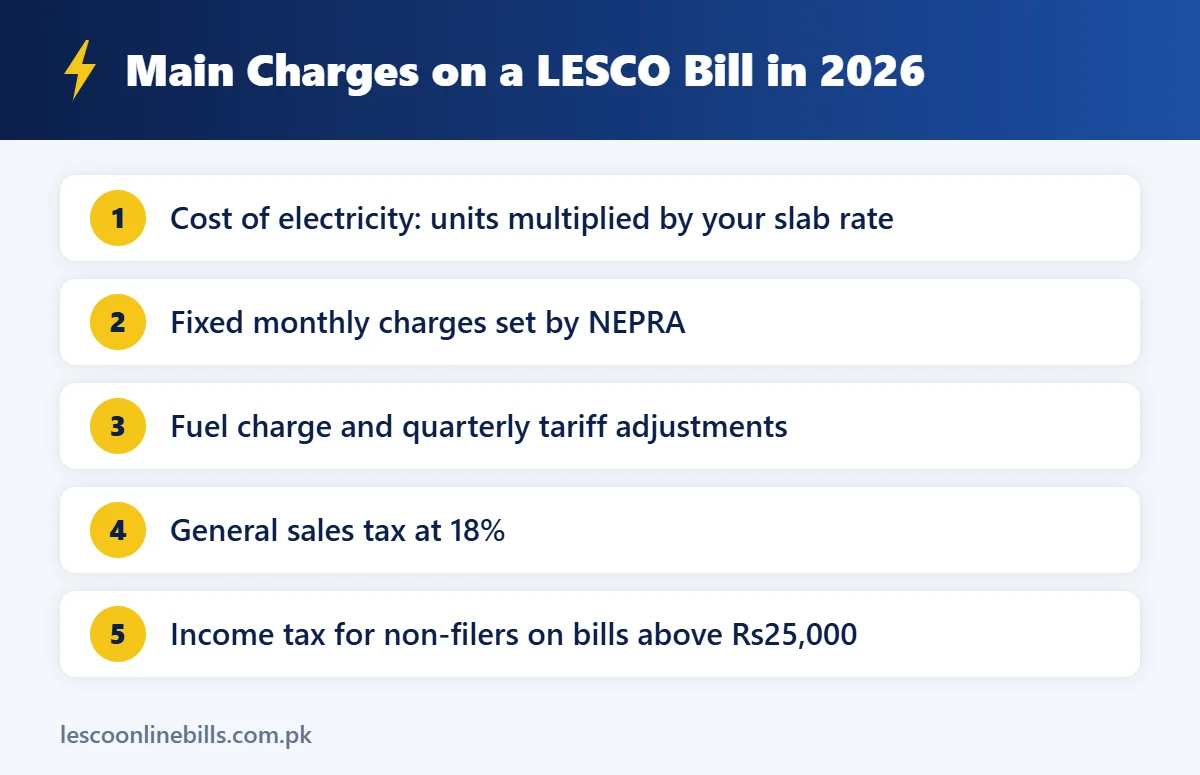
| Charge | What it is | Current position (2026) |
|---|---|---|
| Cost of electricity | Units used multiplied by your slab rate | From Rs3.95 (lifeline) to about Rs47 per unit (above 700 units) |
| Fixed charges | A monthly charge for domestic consumers | Approved by NEPRA in February 2026; lifeline exempt |
| Fuel charge adjustment (FCA/FPA) | Monthly change in fuel cost | October 2026 bills: plus Rs1.11 per unit |
| Quarterly tariff adjustment (QTA) | Quarterly change in other power costs | About 52 paisa per unit, September to November 2026 |
| General sales tax (GST) | Federal sales tax | 18% |
| Income tax | Advance tax for people not on the Active Taxpayers List | 7.5% on domestic bills above Rs25,000 |
| Late payment surcharge | Penalty for paying after the due date | 10% of the bill |
Cost of electricity
This is the base price of the units you used, worked out by slab. NEPRA kept base tariffs unchanged for 2026. For example, protected consumers pay Rs10.54 for the first 100 units and Rs13.01 for the next 100, while non-protected consumers pay Rs22.44 and Rs28.91 for the same slabs. See all slabs on our LESCO unit rate page.
Since 2026, most homes also pay a separate fixed charge. See the full rate table in our LESCO fixed charges guide.
Fixed charges
NEPRA approved fixed monthly charges for domestic consumers in February 2026. For protected consumers they are Rs200 up to 100 units and Rs300 up to 200 units, and for non-protected consumers they rise in steps up to Rs675 for the highest users. Lifeline consumers are exempt. Your exact amount appears in the QR breakdown.
Fuel charge adjustment
The fuel cost of generating electricity changes every month, and NEPRA passes the difference to consumers about two months later. It can be an increase or a refund. October 2026 bills include an increase of Rs1.11 per unit for August 2026. Lifeline consumers, EV charging stations and prepaid consumers are exempt.
Quarterly tariff adjustment
This covers other changes in power costs and is applied for three months at a time. NEPRA allowed an increase of about 52 paisa per unit for September, October and November 2026 bills, with lifeline consumers exempt. Earlier, June to August 2026 bills carried a cut of Rs1.98 per unit.
General sales tax
GST of 18% is charged on the value of electricity supplied. It is one of the largest LESCO bill taxes, because it is calculated on the cost of electricity plus the adjustments.
Income tax for non-filers
Under section 235 of the Income Tax Ordinance, domestic consumers who are not on the Active Taxpayers List pay advance income tax of 7.5% when the monthly bill is above Rs25,000. Bills up to Rs25,000 are not charged. Filers on the list are not charged this tax.
Late payment surcharge
If you pay after the due date, a surcharge of 10% is added. This is not a tax, but it is the easiest charge to avoid. Our guide on checking if your LESCO bill is paid also explains why you should not wait until the last evening.
LESCO Bill Taxes That Were Removed
| Charge | What happened |
|---|---|
| Electricity duty | Stopped from July 2025; it used to be 1.5% for homes and shops |
| PTV fee (Rs35) | Removed from bills in July 2025 |
| Neelum-Jhelum surcharge | Withdrawn in February 2021 |
If any of these still appear in your QR breakdown, ask your sub-division office for a correction.
How LESCO Bill Taxes Changed in 2025 and 2026
If your bill looks different from last year, these changes explain why:
- July 2025: electricity duty and the Rs35 PTV fee were removed, so two familiar LESCO bill taxes disappeared.
- January 2026: NEPRA kept base tariffs unchanged for the calendar year.
- February 2026: new fixed monthly charges were approved for domestic consumers, with lifeline users exempt.
- May 2026: bills of subsidised consumers started showing the monthly subsidy amount and a registration QR code.
- June 2026: the simplified bill layout arrived, showing LESCO bill taxes and adjustments as a combined figure with details behind a QR code.
How to Check LESCO Bill Taxes Step by Step
- Open your latest bill online or take the paper bill.
- Scan the tax QR code to see the full list of charges.
- Check the units against your meter and your slab against the unit rate table.
- Make sure GST is 18% and is worked out on the right base.
- If your bill is above Rs25,000, check whether income tax was charged and whether you are a filer.
- Confirm that electricity duty and the PTV fee are not on the list.
- If anything looks wrong, take the bill to your sub-division before the due date.
Doing this once every few months takes ten minutes and is the best way to make sure your LESCO bill taxes are correct.
Who Decides LESCO Bill Taxes?
LESCO only collects most of these charges. The Federal Board of Revenue and the federal budget decide sales tax and income tax rates. NEPRA, the power regulator, decides base tariffs and the monthly and quarterly adjustments after public hearings. The federal government notifies the final tariff. So when LESCO bill taxes go up or down, the change usually comes from a budget or a NEPRA decision, not from LESCO itself. You can follow these decisions on the NEPRA website.
LESCO Bill Taxes for Filers vs Non-Filers
The difference between a filer and a non-filer only matters for income tax, and only when the bill is above Rs25,000. For a Rs30,000 bill, a non-filer pays about Rs2,250 extra in income tax, while a filer pays nothing. If you are on the Active Taxpayers List but still see income tax on your bill, contact your sub-division with proof of your status and ask for it to be updated. You can usually adjust advance tax paid through bills against your annual return.
Commercial and Industrial Bills
LESCO bill taxes are heavier for businesses. For commercial consumers, advance income tax is nil up to Rs500, 10% on bills from Rs501 to Rs20,000, and Rs1,950 plus 12% of the amount above Rs20,000 for larger bills. Commercial and industrial consumers who are not registered for sales tax or not on the Active Taxpayers List may also pay further tax and extra tax. Shop owners should register to avoid these extra charges.
A Simple Example
Here is a rough example for a non-protected home using 300 units in October 2026, using base rates and leaving out smaller items:
- Energy: 100 units at Rs22.44 + 100 at Rs28.91 + 100 at Rs33.10 = about Rs8,445
- Fuel adjustment: 300 x Rs1.11 = about Rs333
- Quarterly adjustment: 300 x Rs0.52 = about Rs156
- Fixed charge: Rs350
- GST at 18% on the total so far: about Rs1,670
That brings the bill to roughly Rs10,950 before any other surcharges, and no income tax because it is below Rs25,000. Your real bill can differ, so use our LESCO bill calculator for an estimate and the QR code for exact figures.
How to Pay Less: Legal Ways to Reduce LESCO Bill Taxes
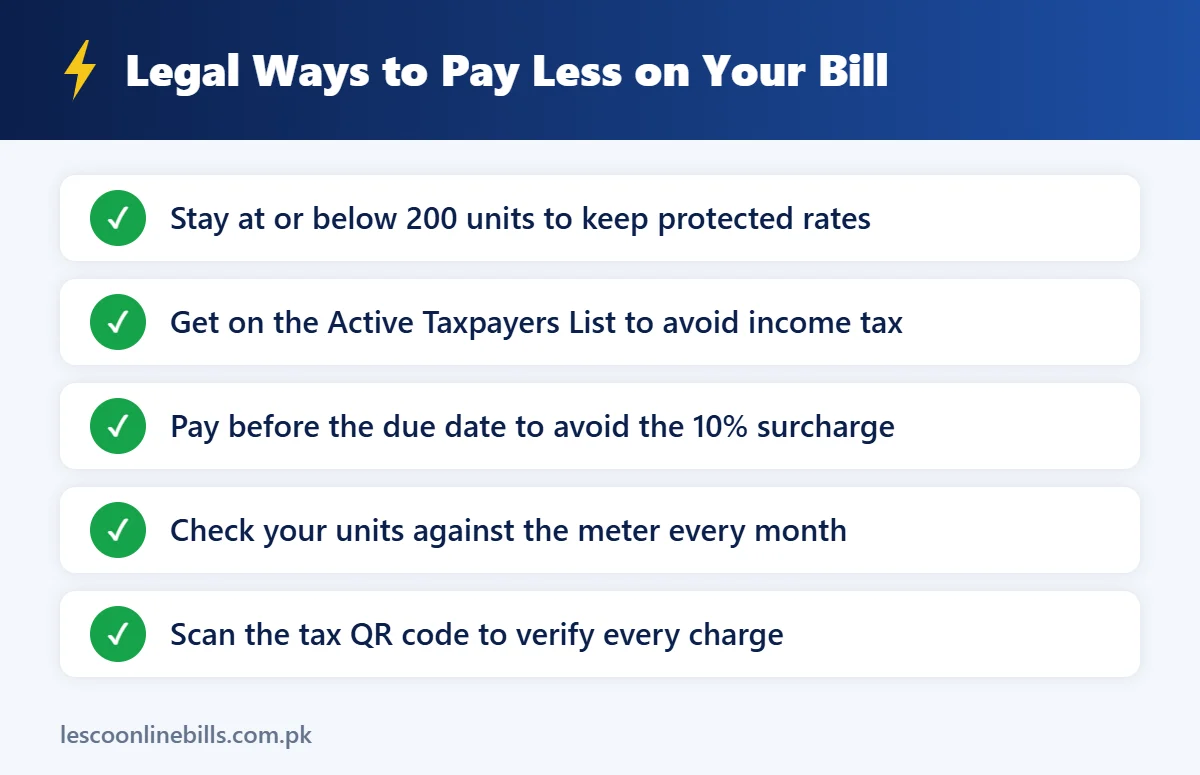
- Stay protected: keep every month at or below 200 units to pay protected rates and lower fixed charges. Read our LESCO bill subsidy guide.
- Become a filer: being on the Active Taxpayers List removes income tax on large bills.
- Pay on time: avoid the 10% late payment surcharge.
- Watch your slab: a few extra units can push you into a higher rate, and GST is charged on the higher amount.
- Check readings: compare the bill with your meter and your LESCO previous bill history.
For a line-by-line walk-through of every section of the bill, including where these taxes appear, read our LESCO bill explained guide.
LESCO Bill Taxes FAQs
Why are taxes not listed on my new LESCO bill?
Since June 2026 the bill shows a combined amount. The full list of LESCO bill taxes is available by scanning the tax QR code.
Is electricity duty still charged on LESCO bills?
No. Electricity duty was stopped from July 2025.
Is the PTV fee still on the bill?
No. The Rs35 PTV fee was removed in July 2025.
Who pays income tax on a LESCO bill?
Domestic consumers not on the Active Taxpayers List, when the monthly bill is above Rs25,000. The rate is 7.5%.
What is the GST rate on LESCO bills?
18%.
Can I get a refund of taxes charged by mistake?
Yes. Take your bill and proof, such as ATL status, to your sub-division and ask for a correction. If it is not resolved, call 118.
Final Words
LESCO bill taxes can add a large share to your total, but they follow clear rules. Scan the tax QR code to see each charge, check that removed items like electricity duty and the PTV fee are not there, and use the legal ways above to pay less: stay protected if you can, become a filer, and always pay before the due date.