LESCO Sanctioned Load: Meaning, How to Check It and Why It Matters in 2026
Most people never look at the small field on their bill that says “Load” or “Sanctioned Load”. Since the 2026 tariff changes, that number can affect how much you pay every month. Understanding your LESCO sanctioned load helps you avoid higher fixed charges, overloaded wiring and surprise bills.
This guide explains what sanctioned load means, where to find it, how to calculate your real load, how it affects your bill and how to increase or reduce it. You can open your bill now on our LESCO bill check page and follow along.
Table of Contents
What Is LESCO Sanctioned Load?
Every electricity connection is approved for a certain maximum load, measured in kilowatts (kW). That approved limit is your LESCO sanctioned load. It is decided when your connection is first installed, based on the load you applied for, and it changes only when you apply for an extension or another approved change.
Think of it as the size of the pipe that brings electricity to your home. A small pipe is fine for fans and lights. A house with several ACs, an electric water heater and a big water pump needs a bigger one.
Three related terms often get mixed up:
| Term | Meaning |
|---|---|
| Sanctioned load | The maximum load LESCO has approved for your connection, in kW |
| Connected load | The total wattage of all appliances installed in your home |
| Units (kWh) | The energy you actually use in a month, which decides most of the bill |
Where to Find Your Sanctioned Load on the Bill
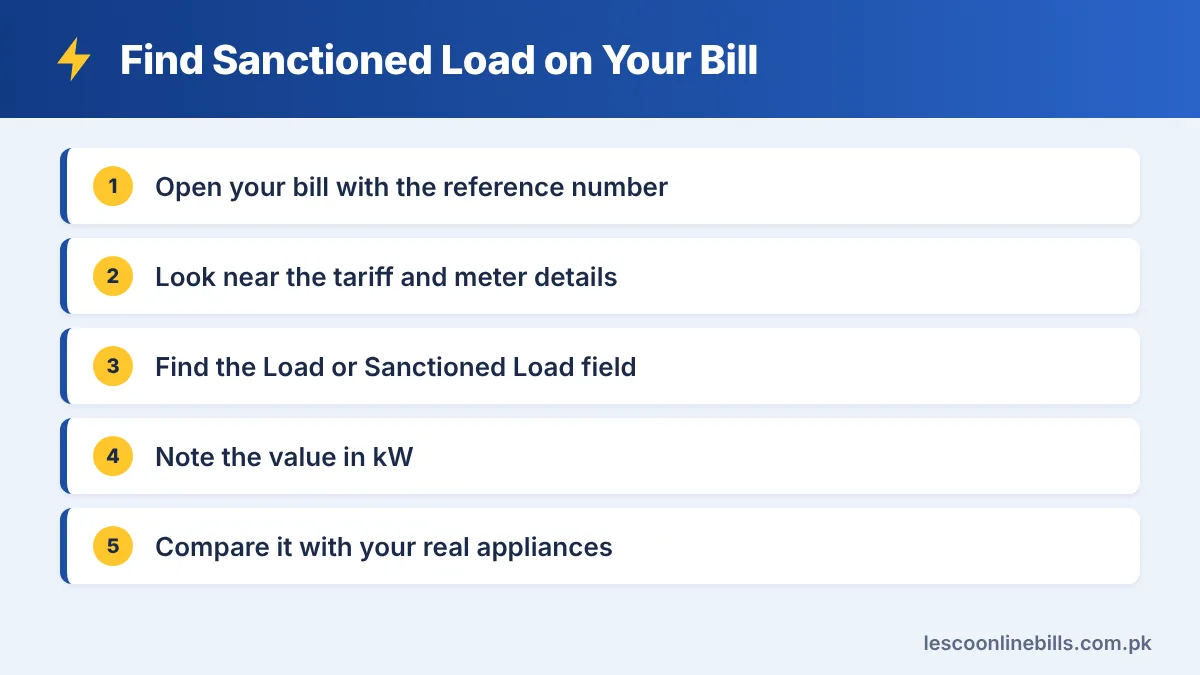
- Open your bill with your 14-digit reference number, online or on paper.
- Look at the connection details near the tariff and meter number.
- Find the field labelled Load or Sanctioned Load.
- Note the value in kW, for example 2 or 5.
Our LESCO bill explained guide shows every part of the bill with pictures. If you do not have the reference number, see LESCO reference number.
Why LESCO Sanctioned Load Matters in 2026
Until recently, many homes could ignore their sanctioned load. That changed in February 2026, when NEPRA restructured domestic tariffs. The new domestic fixed charges are listed per kW of sanctioned load per month, from Rs200 to Rs675 depending on your units and protected status.
That means two homes using the same number of units can pay different fixed charges if their LESCO sanctioned load is different. For example, at the Rs350 per kW rate for 201–300 units, a 2 kW load and a 5 kW load lead to very different fixed amounts. Our LESCO fixed charges guide has the full table and examples.
Your sanctioned load also matters for safety. If you run far more load than your connection and wiring were built for, cables overheat, breakers trip and meters can burn.
How to Calculate Your Real Load
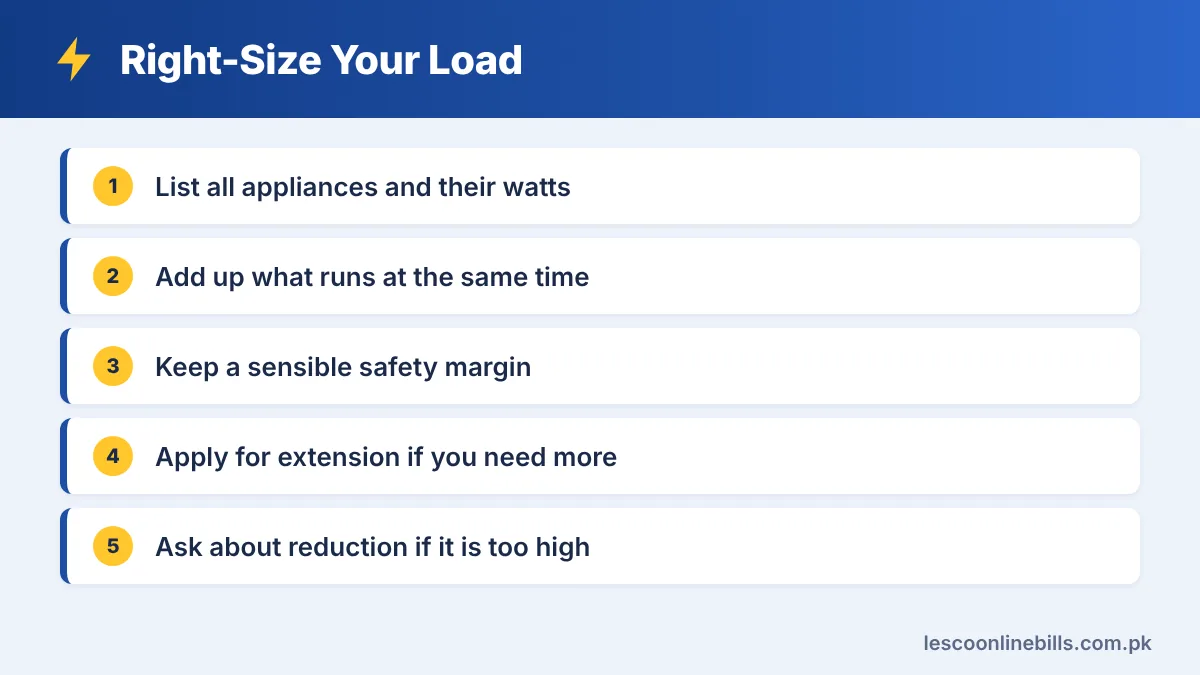
Before you change your LESCO sanctioned load, work out what you really need. Follow these steps:
- List every appliance in the house.
- Write the wattage of each one (on the label or in the manual).
- Mark which appliances run at the same time on a hot summer evening.
- Add up the watts of those appliances.
- Divide by 1,000 to convert watts to kW.
- Add a sensible margin for starting current and future needs.
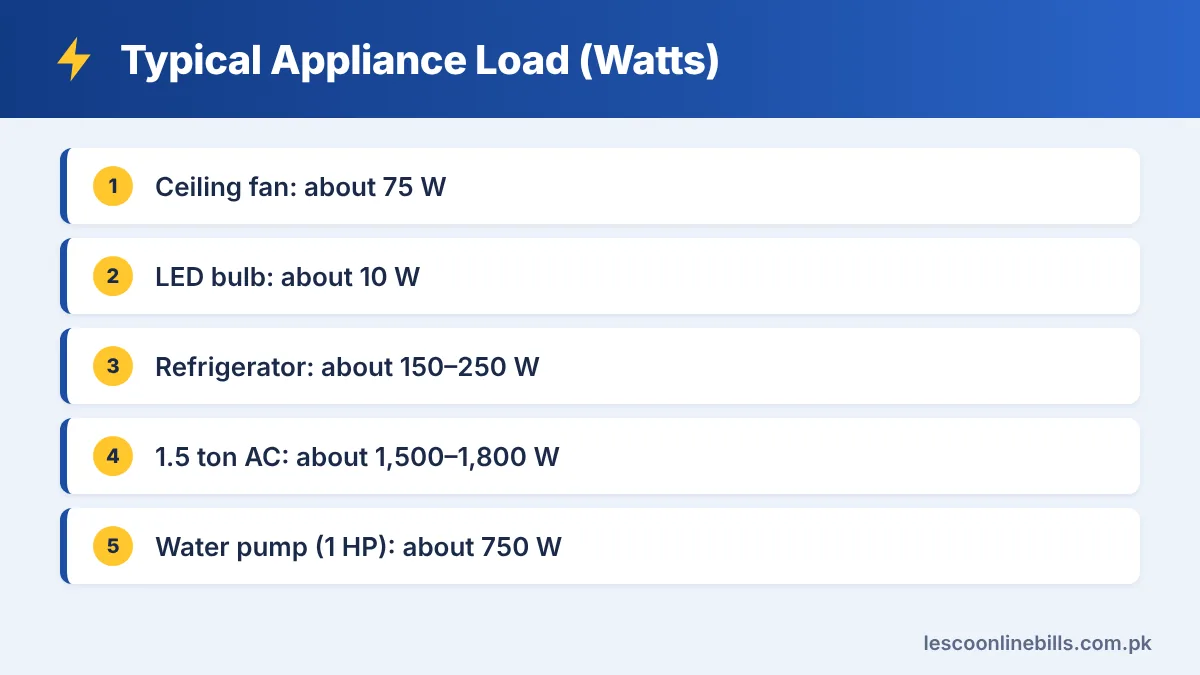
Here are typical wattages to help you estimate:
| Appliance | Typical power |
|---|---|
| Ceiling fan | About 75 W |
| LED bulb | About 10 W |
| Refrigerator | About 150 to 250 W |
| LED TV | About 60 to 120 W |
| 1.5 ton AC | About 1,500 to 1,800 W |
| Iron | About 1,000 W |
| Water pump (1 HP) | About 750 W |
| Microwave oven | About 1,000 to 1,200 W |
| Washing machine | About 400 to 500 W |
These are rough figures. Inverter ACs and newer appliances often use less, while older ones may use more. Always check the label.
Example Calculation
A family runs 6 fans (450 W), 10 LED bulbs (100 W), a fridge (200 W), a TV (100 W) and one 1.5 ton AC (1,700 W) at the same time on a summer night. That adds up to about 2,550 W, or 2.55 kW. If they also run the water pump (750 W) now and then, the peak is about 3.3 kW. A LESCO sanctioned load of around 4 kW would give a sensible margin.
Single Phase or Three Phase?
Smaller loads are usually supplied through a single phase connection, while larger homes and businesses with many ACs or heavy machines need three phase supply. The exact limits and options for your case are decided by LESCO when you apply. Our LESCO load extension guide explains when a change to three phase is needed, and our LESCO meter price guide shows the costs.
How to Increase Your LESCO Sanctioned Load
- Calculate the load you really need.
- Get your house wiring checked and a test report from a qualified electrician.
- Apply for a load extension online or at your sub-division with your bill and CNIC.
- Wait for the site survey.
- Pay the demand notice for the extra load.
- LESCO updates your connection and your new LESCO sanctioned load appears on later bills.
The full process and fees are in our load extension guide, and the payment step is explained in LESCO demand notice.
Can You Reduce Your Sanctioned Load?
If your LESCO sanctioned load is much higher than you need, for example because a previous owner ran a business from the house, it may be worth asking about a reduction. Visit your sub-division with your latest bill, CNIC and ownership or tenancy papers, and ask about the current procedure, documents and any conditions.
Do not reduce your load below what you really use. If your peak use is higher than your approved load, you risk tripping, overheating and problems later when you add appliances.
LESCO Sanctioned Load and Solar
Solar users should pay special attention to sanctioned load. Net metering applications usually link the size of your solar system to your approved load, so a very low LESCO sanctioned load can limit the system you are allowed to connect. Plan your load and solar together. Our LESCO net metering guide explains the solar side.
Commercial Connections and MDI
Shops, offices and industries are billed under different tariffs. Larger commercial and industrial connections may have an MDI (Maximum Demand Indicator) reading on the bill, which records the highest demand in the month and can affect charges. If you run a business, ask your sub-division how sanctioned load and maximum demand apply to your tariff.
Fixed Charges by LESCO Sanctioned Load: Examples
The table below shows how the per-kW fixed charge rates from the February 2026 schedule work out for different sanctioned loads. These are simple examples based on the published rates; your bill shows the amount actually applied.
| Status and units | Rate per kW | 2 kW load | 4 kW load |
|---|---|---|---|
| Protected, 101–200 units | Rs300 | Rs600 | Rs1,200 |
| Unprotected, 201–300 units | Rs350 | Rs700 | Rs1,400 |
| Unprotected, 401–500 units | Rs500 | Rs1,000 | Rs2,000 |
The difference grows every month, which is why an accurate LESCO sanctioned load is worth checking.
After Buying or Renting a House
When you buy a house, you inherit its connection, including its LESCO sanctioned load. The previous owner may have run a shop, a tuition centre or a workshop and asked for a much higher load. Check the bill before you move in, and ask your sub-division about the correct procedure if the load no longer suits you. Do the name change at the same time; our LESCO change of name guide explains how.
Tenants should also check the load before signing. A low LESCO sanctioned load in a house with many ACs means tripping and possible damage, and a very high load can mean higher fixed charges every month.
Make Sure Your Wiring Matches Your Load
A higher LESCO sanctioned load is only safe if the wiring inside your house can carry it. Old thin cables, loose joints and cheap breakers are a common cause of fires in summer. Before you add load:
- Get a qualified electrician to check cable sizes from the meter to the main board.
- Use a proper main breaker rated for your load.
- Give ACs and water heaters their own circuits and breakers.
- Use earthing for appliances with metal bodies.
These checks protect your family and your appliances, and they are needed for the wiring test report when you apply for a load change.
Signs Your LESCO Sanctioned Load Is Too Low
- The main breaker trips when the AC and water pump run together.
- Lights dim when a heavy appliance starts.
- Wires or the meter area feel warm.
- You have added several appliances since the connection was installed.
If you notice these signs, get your wiring checked and apply for the right LESCO sanctioned load. It is safer and avoids damage to appliances.
Signs Your LESCO Sanctioned Load Is Too High
- The bill shows a load far above what your family uses.
- A business used to run from the property but no longer does.
- Your fixed charges seem high compared with neighbours who use similar units.
Check Your LESCO Sanctioned Load Every Year
Families change, and so do their appliances. Once a year, ideally before summer, compare your LESCO sanctioned load with the appliances you now use. A new AC, a second fridge or an electric water heater can push your peak load above what was approved years ago. Fixing the load before summer is easier than dealing with tripping breakers and burnt wires in the middle of a heatwave.
Keep your bill copies so you can see whether the load printed on them has ever changed. If it suddenly changes without any request from you, ask your sub-division for the reason.
Ways to Lower Your Peak Load Without Changing Anything on Paper
Sometimes the cheapest fix is not a new sanctioned load but smarter use. If your breaker trips or your peak is close to your limit, try these habits first:
- Stagger heavy appliances: do not run the iron, microwave and water pump at the same time as the AC.
- Fill the water tank in the morning when ACs are off.
- Switch to inverter ACs and LED lights, which draw less power for the same comfort.
- Use a timer for the water heater or pump so they run at quieter times.
- Service your AC before summer; dirty filters make it work harder and draw more.
These steps lower both your peak load and your monthly units. If your use falls enough, you may even stay in a lower slab, which helps with unit rates and fixed charges. Use our LESCO bill calculator to see how fewer units change your bill.
When to Ask an Expert
If you run a home business, have a large house with several ACs, or plan solar in the next year, talk to a qualified electrician and your sub-division before deciding your LESCO sanctioned load. A short conversation now can save you from paying twice for load changes and from safety problems later.
Keep Your Papers Ready
Whether you want to increase or reduce your load, the same papers usually help: your latest bill, the account holder’s CNIC, proof of ownership or a tenancy agreement with the owner’s consent, and a wiring test report from a qualified electrician. Keeping these in one folder makes any request faster. Track online requests the same way you track a new connection; see our LESCO new connection tracking guide for tips.
Common Myths About Sanctioned Load
- “Sanctioned load is the same as units.” No. Load is the maximum power in kW; units are the energy you use in kWh.
- “Higher load always means a higher bill.” Units still decide most of the bill, but in 2026 the fixed charge is linked to load too.
- “Load never matters for homes.” It affects safety, fixed charges and solar approvals.
- “I can change it by phone.” Load changes need a formal application and a site check.
Sanctioned Load Checklist
- Find your LESCO sanctioned load on the bill.
- List your appliances and work out your real peak load.
- Compare the two before summer each year.
- Apply for an extension if you need more.
- Ask about reduction only if the load is clearly too high.
- Check how load affects your fixed charges.
- Keep your bill, CNIC and wiring report ready for any change.
LESCO Sanctioned Load FAQs
What is LESCO sanctioned load?
It is the maximum electrical load, in kilowatts (kW), that LESCO has approved for your connection. It is set when your connection is installed or when you apply for a load change, and it is printed on your bill.
Where can I see my sanctioned load?
Open your LESCO bill online or on paper and look near the tariff, meter and connection details for the Load or Sanctioned Load field. The value is shown in kW.
Does sanctioned load affect my bill?
Yes. Since the 2026 tariff changes, domestic fixed charges are listed per kW of sanctioned load, so a higher sanctioned load can mean higher fixed charges. It also decides whether your supply is suitable for the appliances you run.
How do I increase my LESCO sanctioned load?
Apply for a load extension online or at your sub-division with your bill, CNIC and wiring details. LESCO checks the site, issues a demand notice and updates your load after payment.
Can I reduce my sanctioned load?
You can ask your sub-division about reducing your sanctioned load if it is much higher than you need. LESCO will check your connection and explain the procedure and any conditions.
What happens if I use more than my sanctioned load?
Running more load than approved can overload your meter and cables, cause tripping and create safety risks. For some categories it can also lead to extra charges. Apply for the correct load instead.
Final Words
Your LESCO sanctioned load is a small number with big effects. It decides how much load your connection can safely carry and, since 2026, it affects your monthly fixed charges. Find it on your bill, compare it with your real needs, and keep it accurate through a load extension or a reduction request when needed. A correctly sized load keeps your home safe and your bill fair.