LESCO Meter Change 2026: Replace a Burnt, Slow or Faulty Meter (Rules and Charges)
A burnt, slow, fast or broken meter can turn your electricity bill upside down. A LESCO meter change fixes the problem, but only if you follow the right steps and know who should pay. Many consumers wait months, pay for meters that should have been free or accept average bills far longer than the rules allow.
This guide covers the whole LESCO meter change process in 2026: when a meter must be replaced, how to apply, who pays, how you are billed while the meter is faulty, how to challenge a fast meter, what meter shifting costs and what to check after the new meter is installed.
Table of Contents
When Do You Need a LESCO Meter Change?
A LESCO meter change is needed whenever the meter can no longer record your units correctly or safely. The most common reasons are:
- Burnt meter: smoke marks, a melted body or no display after a fault or heavy load.
- Blank or washed display: the screen is empty, faded or unreadable.
- Slow or stuck meter: units barely move even when heavy appliances run.
- Fast meter: units jump without a matching change in your usage.
- Physical damage: broken glass, damaged box or loose terminals.
- Load change: moving from single-phase to three-phase after a load increase.
- Meter shifting: moving the meter to another wall or position during construction.
If you are not sure the meter is faulty, compare your own readings with the bill first. Our LESCO meter reading guide explains how to read the display and calculate units.
NEPRA Rules on Defective Meters
The NEPRA Consumer Service Manual sets clear rules for defective meters, and they apply to every LESCO meter change:
- Replacement time: a defective or burnt meter must be replaced immediately, or within two billing cycles if meters are not available.
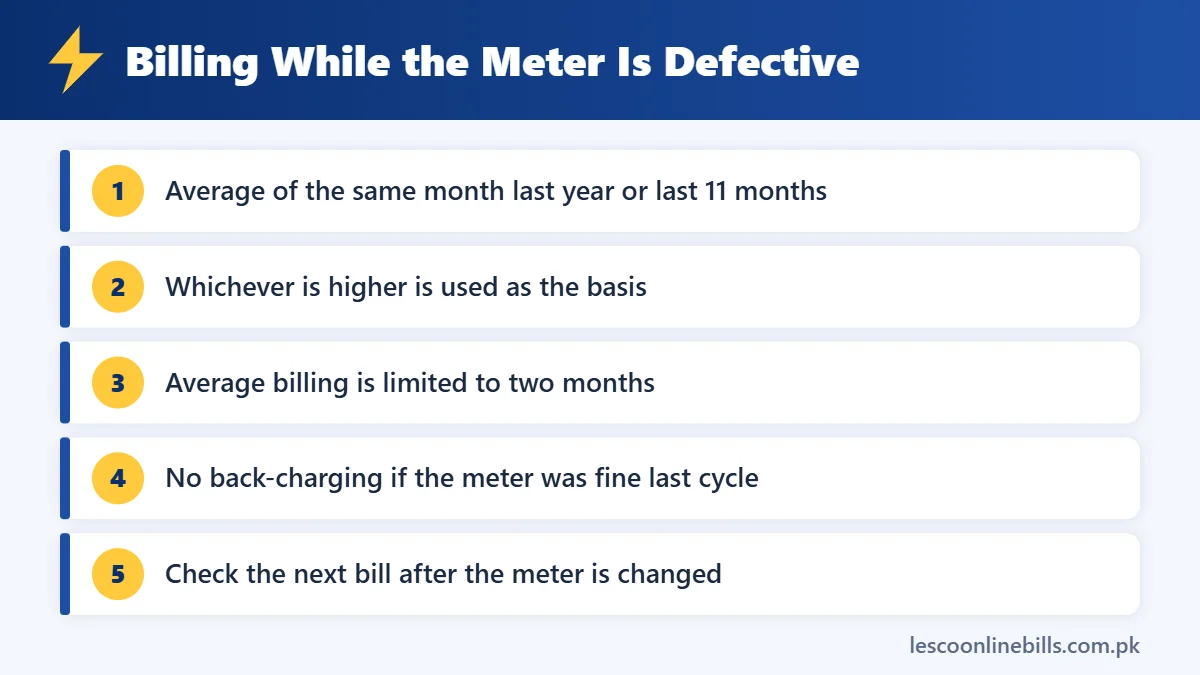
- Average billing: while the meter is defective, you can be billed on the higher of the same month last year or the average of the last 11 months, for a maximum of two months.
- No back-charging: if the meter was recording correctly up to the last billing cycle, old units cannot be added afterwards.
- Washed display: if data from a washed meter is recovered, actual units are charged after notice. If it is not recovered within three months (six if sent to the manufacturer), no extra charge is allowed.
In October 2026, the Power Division repeated these limits, stating that replacement should happen within two billing cycles and average billing should not exceed two months. You can read the manual on the NEPRA website.
How to Apply for a LESCO Meter Change
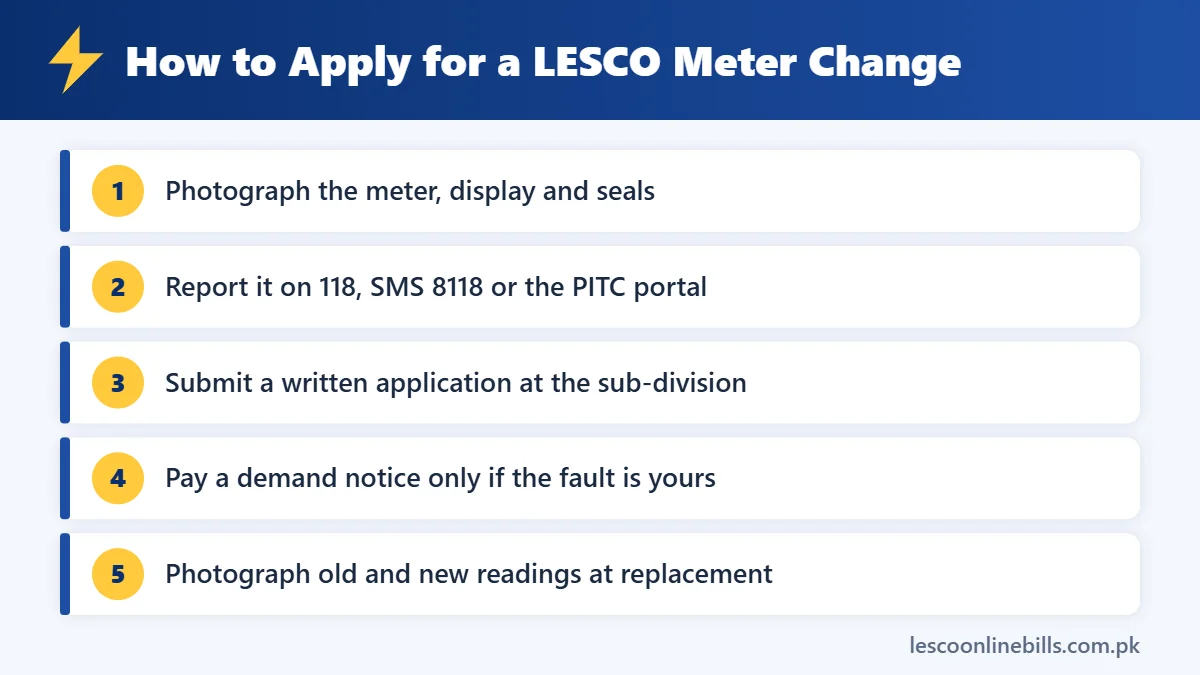
- Collect evidence: photograph the meter, the display (or blank screen), the seals and the meter box. Note the date.
- Report the fault: call 118, send an SMS to 8118 or use the PITC complaint system. Save the complaint number.
- Apply in writing: submit an application at your sub-division with the latest bill, CNIC copy and photos. Ask for the application to be stamped as received.
- Site inspection: LESCO staff inspect the meter and decide whether it is defective and why.
- Demand notice if applicable: you pay only if the fault is your responsibility. Otherwise, LESCO bears the cost.
- Replacement: the team installs the new meter. Photograph the final reading of the old meter and the starting reading of the new one.
Our LESCO complaint guide lists every official channel, and our LESCO helpline guide has the contact numbers.
Who Pays for a LESCO Meter Change?
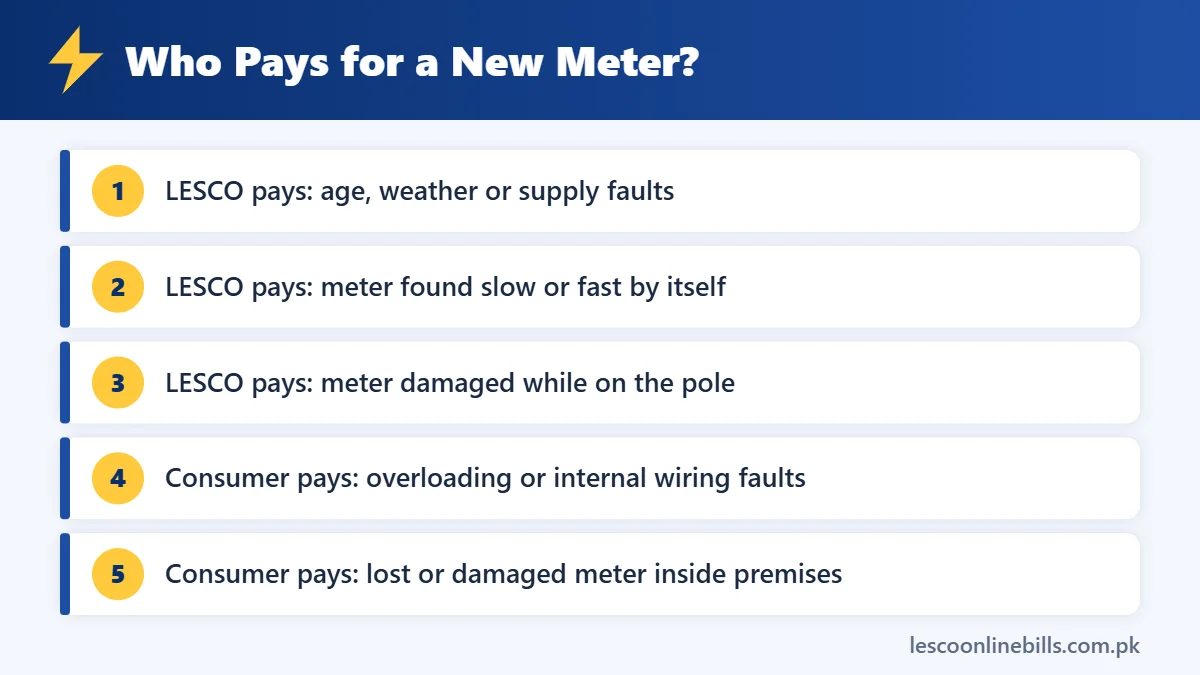
This is where many consumers lose money. Under clause 4.4 of the manual, responsibility depends on the cause of the fault:
| Cause of fault | Who pays |
|---|---|
| Age, wear or weather | LESCO |
| Meter running slow or fast by itself | LESCO |
| Supply fault from LESCO’s side | LESCO |
| Meter on a pole damaged or lost | LESCO |
| Overloading by the consumer | Consumer |
| Fault in the consumer’s internal wiring | Consumer |
| Meter inside the premises lost or damaged in an accident | Consumer |
LESCO announced free replacement of burnt meters in July 2025, and in June 2026 it said defective single-phase meters would be replaced with static meters free of charge. If you are asked to pay for a LESCO meter change that was not your fault, ask for the reason in writing and for an official demand notice.
Meter Shortages and Delays in 2025 and 2026
LESCO has faced serious meter shortages. In December 2025, around 102,000 single-phase and 2,400 three-phase meters were reported defective, with a shortage expected to last six months. In April 2026, replacements were reported to be halted for a period because of low stock. Later in 2026, LESCO approved about 400,000 static meters to clear the backlog.
If your LESCO meter change is delayed, remember the two-month limit on average billing. Even when stock is short, you should not keep receiving estimated bills month after month. Mention the rule in your follow-up and escalate if needed.
How You Are Billed While the Meter Is Defective
Until the LESCO meter change happens, your bill is estimated. Under the manual, the basis is the higher of:
- your units in the same month of the previous year, or
- the average of your last 11 months.
This average billing is limited to two months. After the new meter is installed, actual readings resume. If you were away and your house was empty during average billing, you can prove it with documents and ask that only minimum charges apply. For any wrong estimate, our LESCO bill correction guide shows how to ask for a revised bill.
Fast or Slow Meter: Challenge and Check Meter
If you believe your meter is fast, you can challenge its accuracy. The manual sets a challenge fee of Rs500 for single-phase and Rs1,000 for three-phase meters. After you pay, the meter must be checked within seven working days in your presence.
LESCO can also install a tested check meter in series with your meter to compare readings. If the meter is found fast, excess units are credited for up to two previous billing cycles, and LESCO replaces the meter at its own cost. If the meter is found slow, LESCO can charge the difference for the same maximum period. NEPRA confirmed this two-cycle limit in 2024 when it rejected a request from distribution companies to extend it.
For a further independent test, you can approach the Electric Inspector or Provincial Office of Inspection. The test should be done within a month, and the meter should not be removed before it.
Meter Shifting: Charges and Process
Sometimes you need a LESCO meter change of location rather than a new meter, for example during renovation or when building a boundary wall. Under clause 4.2.8 of the manual:
- Apply in person at the sub-division or online where the option is available.
- LESCO surveys the site within seven days.
- A demand notice is issued for the shifting charges.
- After payment, the meter is moved and sealed in its new position.
| Meter type | Shifting charge (manual) |
|---|---|
| Single-phase | Rs500 plus extra material |
| Three-phase | Rs1,000 plus extra material |
Never shift a meter yourself or through a private electrician. Moving a sealed meter without LESCO can be treated as tampering and may lead to a detection bill. Our LESCO detection bill guide explains why.
Smart Meter or Static Meter?
In 2026 your replacement may be a static meter or an AMI smart meter, depending on stock and your area. Static meters are being used for many defective replacements, while AMI meters are going to new connections, solar users and high-loss feeders. In theft or tampering cases, LESCO was reported in October 2026 to charge about Rs14,400 for an AMI meter, compared with about Rs5,500 for a static meter.
Both types show kWh on the display, so you can check them in the same way. Learn more in our LESCO smart meter guide.
Sample Application for a LESCO Meter Change
A written application gives you a dated record, which is useful if the replacement is delayed. Use this sample and change the details to suit your case.
The SDO,
LESCO Sub-Division [name], Lahore.
Subject: Request for LESCO meter change, Reference No. [14 digits]
Sir,
The meter installed at my premises [address] has been [burnt / showing a blank display / running fast] since [date]. I reported it on 118 on [date], complaint number [number]. Photos of the meter and display are attached.
The fault was not caused by overloading or internal wiring. I request that the meter be replaced under the NEPRA Consumer Service Manual within the prescribed time, and that average billing be limited to two months as per the rules.
Name, CNIC, mobile number, signature, date
LESCO Meter Change After a Load Increase
Not every LESCO meter change is about a fault. When you increase your sanctioned load, especially to 5 kW or more, your connection may need a three-phase or time-of-use meter. In that case the meter change is part of the load extension process, and the cost is included in the demand notice for the extra load. Your bill will then show peak and off-peak units separately.
If you are planning solar, check your sanctioned load first. Solar capacity under the 2026 rules cannot exceed sanctioned load, so a load increase and LESCO meter change may come before the solar application. Our LESCO net metering guide explains the solar rules.
Real Example: A Burnt Meter in Peak Summer
Usman’s meter in Shahdara burnt during a hot June night after a voltage fault on the line. He photographed the melted meter, logged a complaint on 118 and submitted a written application at the sub-division the next morning. The inspection report recorded a supply-side fault, so no demand notice was issued.
Because of the meter shortage, the LESCO meter change took about five weeks. During that time he received one average bill based on the same month of the previous year. When a second average bill arrived, he visited the office with his complaint number and pointed out the two-month limit. The new meter was installed within days, and his following bill used actual readings.
His case shows how a dated complaint, clear photos and knowledge of the rules can keep a LESCO meter change on track even when stock is short.
Mistakes to Avoid During a Meter Change
- Paying cash without a receipt: all genuine charges for a LESCO meter change are paid through an official demand notice at a bank.
- Letting a private electrician touch the meter: broken seals can lead to tampering charges.
- Not recording the final reading: without a photo of the old meter’s last reading, disputes are hard to settle.
- Accepting months of average bills: the rules allow only two months, so follow up firmly.
- Ignoring the first new bill: check the starting reading and meter number on the first bill after the change.
What to Check After the New Meter Is Installed
- The final reading of the old meter appears correctly on the next bill.
- The new meter number and starting reading are recorded correctly.
- Average billing stops and actual units are charged.
- No unexpected meter cost appears if LESCO was responsible for the fault.
- The seals on the new meter are intact; photograph them for your records.
Register your mobile number for alerts so you receive the next reading by SMS. Our LESCO SMS registration guide explains how. You can download the next bill on our LESCO bill check online tool.
LESCO Meter Change FAQs
How do I apply for a LESCO meter change?
Report the faulty meter on 118, SMS 8118 or the PITC complaint system, then submit a written application at your sub-division with your bill, CNIC and photos of the meter. Keep the complaint number and the application receipt.
Who pays for a burnt LESCO meter?
If the meter burnt because of age, weather or a supply fault, LESCO bears the cost. If it was damaged by overloading or faults in your internal wiring, you pay through a demand notice.
How long does LESCO take to replace a defective meter?
The NEPRA Consumer Service Manual says a defective meter must be replaced immediately, or within two billing cycles if meters are not available. The Power Division repeated this limit in October 2026.
How is my bill calculated while the meter is defective?
You are billed on the higher of your units in the same month last year or the average of the last 11 months, for a maximum of two months.
How can I get my meter checked if it runs fast?
Apply for a meter check and pay the challenge fee, which the manual sets at Rs500 for single-phase and Rs1,000 for three-phase meters. The meter must be checked within seven working days in your presence, and excess units are credited for up to two billing cycles.
What does it cost to shift a LESCO meter?
Under the manual, meter shifting charges are Rs500 for single-phase and Rs1,000 for three-phase meters, plus the cost of any extra material, paid through a demand notice after a site survey.
Final Words
A LESCO meter change does not have to be a long fight. Report the fault, apply in writing, keep photos and complaint numbers, and remember the key rules: replacement within two billing cycles, average billing for no more than two months and no cost to you when the fault is not yours. Check the first bill after the new meter carefully, and you will be back to accurate billing quickly.